Eras of Indian history · 1947–2026 CE
Independent India: The Republic
Since 1947 India has been an independent democracy. It adopted its Constitution on 26 January 1950, redrew its states largely by language, and has held regular national elections. It moved from a planned economy to a more open one and became one of the world’s largest economies, while facing wars, an Emergency and deep social challenges.
See 2026 CE on the map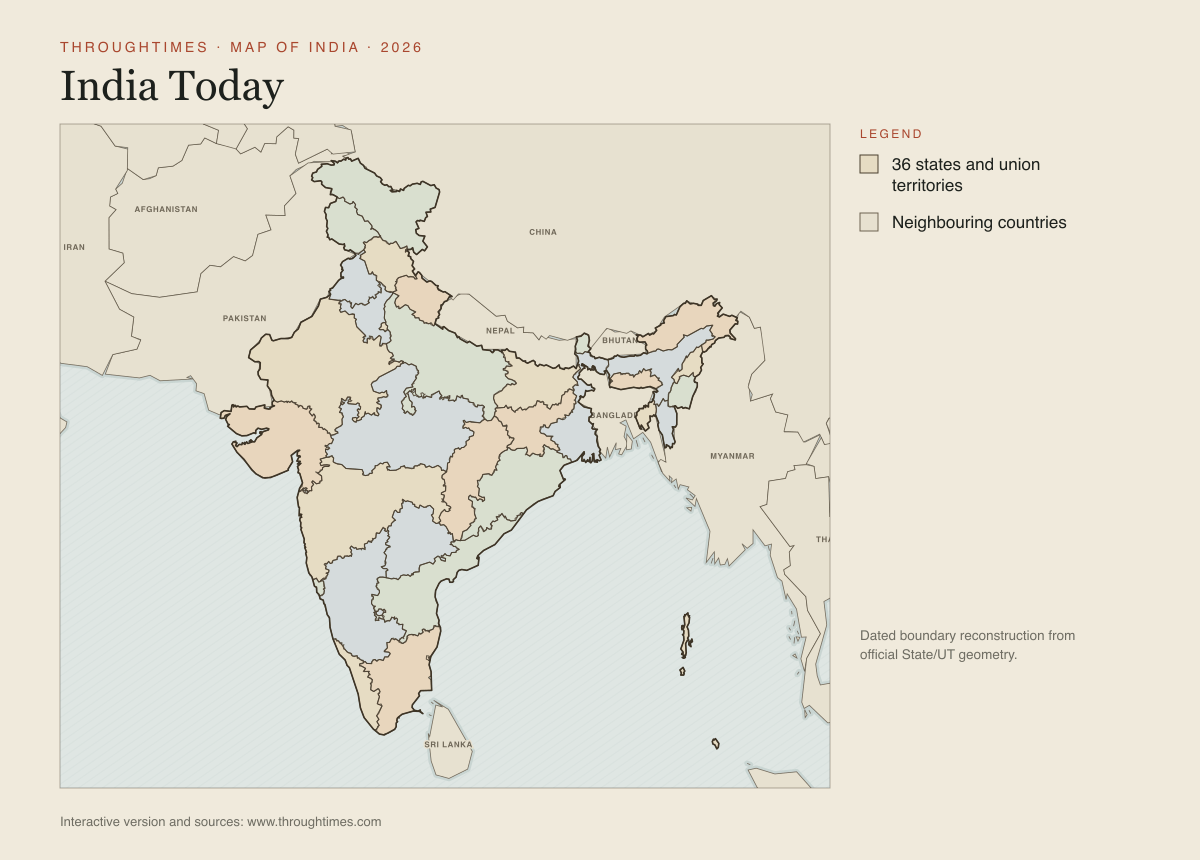
Independent India: The Republic at a glance
- When did it happen?
- 1947 to today; this chapter is updated to 2026.
- Where was it?
- The Union of India, which today has 28 states and 8 union territories.
- Who held power?
- An elected Parliament and Prime Minister under the Constitution, with the President as head of state. Prime ministers have included Jawaharlal Nehru, Indira Gandhi, Atal Bihari Vajpayee, Manmohan Singh and Narendra Modi.
- How did people live?
- Five-Year Plans, the Green Revolution, the economic reforms of 1991, and the growth of IT and services.
- What ideas and culture shaped it?
- Constitutional democracy, secularism, reservations for disadvantaged groups, and nuclear and space programmes.
- How did it end?
- Still unfolding. The atlas follows events up to 2026.
Timeline: how the Independent India era unfolded
- 26 January 1950
The Constitution comes into force and India becomes a republic.
- 1951–52
India holds its first general election.
- 1956
The States Reorganisation Act redraws states largely along language lines.
- December 1971
War with Pakistan; Bangladesh becomes independent.
- 1975–77
The Emergency suspends civil liberties for 21 months.
- July 1991
Economic liberalisation opens up the economy.
- 23 August 2023
Chandrayaan-3 lands near the Moon’s south pole.
The Independent India era, year by year
77 years of this era have a page of their own in the atlas: what happened, who ruled, and the map.
- 1947 CE Independence and Partition
- 1948 CE Mahatma Gandhi is assassinated in Delhi
- 1949 CE Constituent Assembly adopts the Constitution
- 1950 CE Constitution comes into force
- 1951 CE First Five-Year Plan begins
- 1952 CE First general election concludes
- 1953 CE Andhra State creates a linguistic precedent
- 1954 CE The Panchsheel agreement with China
- 1955 CE The Hindu Marriage Act
- 1956 CE States are reorganised
- 1957 CE Kerala’s first communist government
- 1958 CE The Armed Forces (Special Powers) Act
- 1959 CE The Dalai Lama arrives in India
- 1960 CE The Indus Waters Treaty
- 1961 CE Goa, Daman and Diu join India
- 1962 CE India-China war
- 1963 CE Nagaland becomes a state
- 1964 CE Death of Jawaharlal Nehru
- 1965 CE The 1965 India–Pakistan war
- 1966 CE Tashkent and Indira Gandhi
- 1967 CE Green Revolution transforms agriculture
- 1968 CE The Green Revolution takes off
- 1969 CE ISRO is established
- 1970 CE Operation Flood begins
- 1971 CE Bangladesh war reshapes the region
- 1972 CE The Simla Agreement
- 1973 CE The Chipko movement
- 1974 CE Pokhran-I nuclear test
- 1975 CE National Emergency is declared
- 1977 CE Emergency government loses the election
- 1979 CE The Janata government falls
- 1980 CE Indira Gandhi returns to power
- 1981 CE APPLE communication satellite
- 1982 CE Asian Games and colour TV
- 1983 CE India wins the Cricket World Cup
- 1984 CE Bhopal gas disaster
- 1985 CE The Assam Accord
- 1986 CE The Mizo Peace Accord
- 1987 CE Mizoram, Arunachal and Goa become states
- 1988 CE Voting age lowered to 18
- 1989 CE Voting age falls from 21 to 18
- 1990 CE Mandal Commission reservations
- 1991 CE Economic liberalisation begins
- 1992 CE Local government gains constitutional status
- 1993 CE The 1993 Bombay bombings
- 1994 CE The Surat plague outbreak
- 1995 CE Bombay becomes Mumbai
- 1996 CE Vajpayee’s 13-day government
- 1997 CE K.R. Narayanan becomes President
- 1998 CE Pokhran-II nuclear tests
- 1999 CE Kargil conflict
- 2000 CE Three new states are created
- 2001 CE Gujarat earthquake causes widespread destruction
- 2002 CE The 2002 Gujarat violence
- 2003 CE Chandrayaan-1 announced
- 2004 CE The Indian Ocean tsunami devastates India’s coasts
- 2005 CE The Right to Information Act opens public records
- 2006 CE Rural job guarantee (NREGA) begins
- 2007 CE First woman President
- 2008 CE Chandrayaan-1 begins India’s lunar exploration programme
- 2009 CE Right to Education becomes law
- 2010 CE The first Aadhaar number is issued
- 2011 CE Census counts 1.21 billion
- 2013 CE India’s first interplanetary mission reaches Mars
- 2014 CE A new state and transitional capital
- 2015 CE NITI Aayog replaces Planning Commission
- 2016 CE UPI begins as an interoperable payments pilot
- 2017 CE Goods and Services Tax is introduced
- 2018 CE The Supreme Court decriminalises consensual same-sex relations
- 2019 CE Jammu and Kashmir is reorganised
- 2020 CE COVID-19 reshapes public life and migration
- 2021 CE A nationwide COVID-19 vaccination campaign expands
- 2022 CE Droupadi Murmu becomes President
- 2023 CE A constitutional amendment provides for women’s legislative reservation
- 2024 CE India elects the eighteenth Lok Sabha
- 2025 CE Operation Sindoor follows the Pahalgam attack
- 2026 CE A fast breeder reactor reaches first criticality
Kingdoms and powers of this era
Dates are conventional estimates; several of these powers began before or lasted beyond this era.
- Republic of India (1947 CE–today). Union of India: 28 states and 8 union territories today. Independent from 15 August 1947; a republic since 26 January 1950. Read: Independence and Partition, 1947
स्वतंत्र भारत: आसान भाषा में
1947 से भारत एक स्वतंत्र लोकतंत्र है। 26 जनवरी 1950 को संविधान लागू हुआ, राज्यों का पुनर्गठन मुख्यतः भाषा के आधार पर हुआ, और नियमित चुनाव होते रहे। आज भारत में 28 राज्य और 8 केंद्र शासित प्रदेश हैं।
Azad Bharat 1947 se. 26 January 1950 ko Samvidhan lagu hua. Aaj Bharat mein 28 rajya aur 8 kendra shasit pradesh hain.
Sources & further reading
Original plain-language summary. Dates for early periods are scholarly estimates; the sources below give fuller detail.