Eras of Indian history · 1857–1947 CE
India’s Freedom Struggle
From the revolt of 1857 to independence in 1947, Indians organised to end British rule. The movement brought together the Indian National Congress, Gandhi’s non-violent mass campaigns, revolutionaries, peasants, workers and regional leaders. It ended with independence on 15 August 1947, along with the painful Partition of India and Pakistan.
See 1930 CE on the map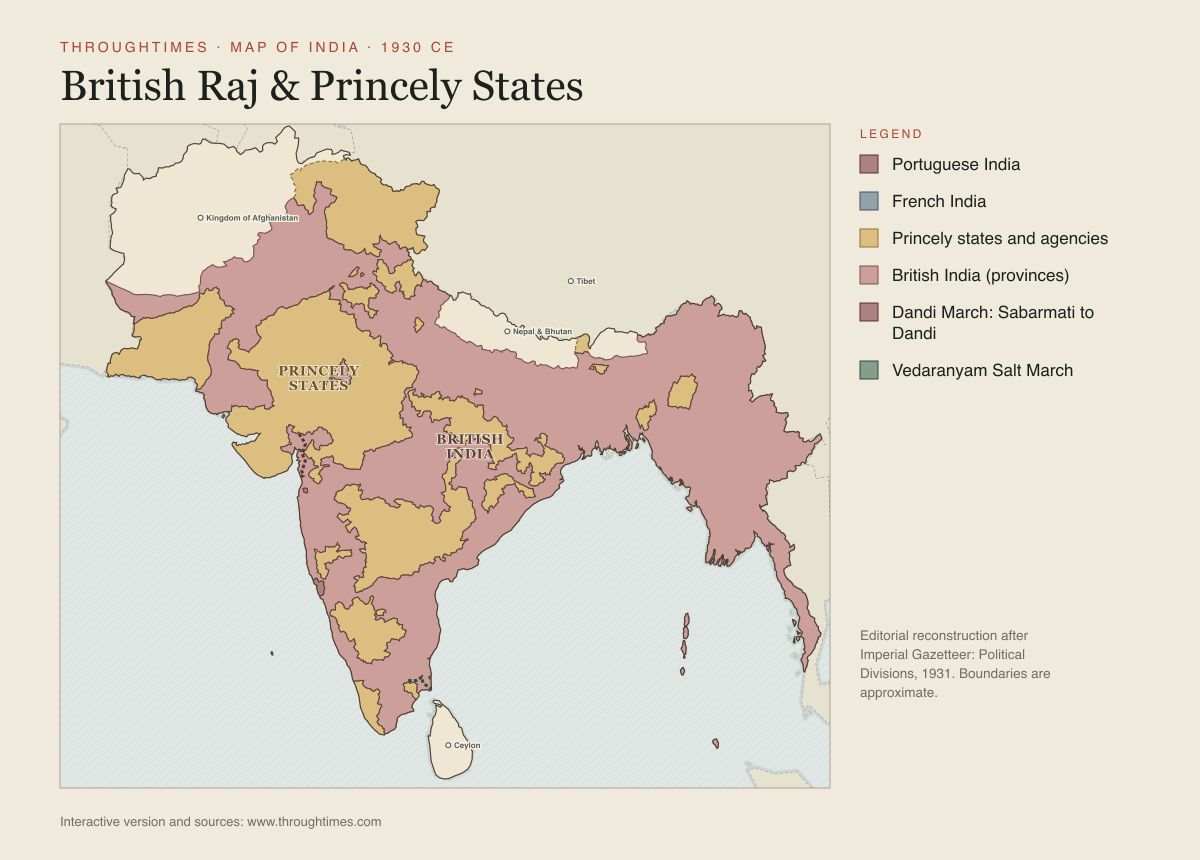
India’s Freedom Struggle at a glance
- When was India’s freedom struggle?
- 1857–1947.
- Where did the freedom struggle take place?
- All of British India and the princely states, with major centres in Bengal, Punjab, Maharashtra, Gujarat, the United Provinces and Madras.
- Who held power?
- The British Raj ruled through a Viceroy. Indian leadership included the Congress (founded 1885) and the Muslim League (1906), and figures such as Tilak, Gandhi, Nehru, Patel, Subhas Chandra Bose, Ambedkar and Jinnah.
- How did people live?
- Famines, cash crops and growing cities; railways linked the country, and Indian soldiers fought in both World Wars.
- What ideas and culture shaped it?
- Swadeshi, satyagraha (non-violent resistance), the demand for purna swaraj (complete independence), and debates on social reform, caste and minority rights.
- How did it end?
- The Indian Independence Act 1947 created two dominions, India and Pakistan. India became independent at midnight on 14–15 August 1947.
Timeline: how the Freedom struggle era unfolded
- December 1885
The Indian National Congress is founded in Bombay.
- 1905
The Partition of Bengal sparks the Swadeshi movement.
- 1915
Gandhi returns to India from South Africa.
- 13 April 1919
The Jallianwala Bagh massacre in Amritsar.
- 1920
The Non-Cooperation Movement begins.
- March–April 1930
Gandhi’s Salt March to Dandi launches civil disobedience.
- August 1942
The Quit India Movement begins.
- 15 August 1947
Independence, together with the Partition of India and Pakistan.
The Freedom struggle era, year by year
87 years of this era have a page of their own in the atlas: what happened, who ruled, and the map.
- 1857 CE A broad uprising challenges Company rule
- 1858 CE Rani of Jhansi killed
- 1859 CE Tantia Tope executed
- 1860 CE Indian Penal Code enacted
- 1861 CE Indian Councils Act 1861
- 1862 CE Last Mughal emperor dies
- 1863 CE Swami Vivekananda born
- 1864 CE Bhutan (Duar) War
- 1865 CE Shimla summer capital
- 1866 CE Brahmo Samaj splits
- 1867 CE Deoband seminary founded
- 1869 CE Gandhi born
- 1870 CE Chittaranjan Das born
- 1871 CE Abanindranath Tagore born
- 1872 CE Lord Mayo assassinated
- 1873 CE Satyashodhak Samaj founded
- 1875 CE Arya Samaj founded
- 1876 CE Indian Association founded
- 1877 CE Delhi Durbar of 1877
- 1878 CE Vernacular Press Act
- 1879 CE Treaty of Gandamak
- 1880 CE Lord Ripon becomes viceroy
- 1881 CE Mysore restored to Wadiyars
- 1882 CE Ripon’s local self-government
- 1883 CE Ilbert Bill controversy
- 1884 CE Rajendra Prasad born
- 1885 CE Indian National Congress first meets
- 1886 CE Ramakrishna dies
- 1887 CE Srinivasa Ramanujan born
- 1888 CE C. V. Raman born
- 1889 CE Jawaharlal Nehru born
- 1890 CE Jyotirao Phule dies
- 1891 CE Age of Consent Act
- 1892 CE Naoroji elected to Parliament
- 1893 CE Vivekananda in Chicago
- 1894 CE Bankim Chandra Chatterjee dies
- 1895 CE Vinoba Bhave born
- 1897 CE Ramakrishna Mission founded
- 1898 CE Sayyid Ahmad Khan dies
- 1899 CE Lord Curzon becomes viceroy
- 1900 CE Birsa Munda and the Ulgulan
- 1901 CE Tagore’s school at Santiniketan
- 1902 CE Death of Swami Vivekananda
- 1903 CE The 1903 Delhi Durbar
- 1904 CE British expedition reaches Lhasa
- 1905 CE Swadeshi follows Bengal’s partition
- 1906 CE All-India Muslim League is founded
- 1907 CE Congress splits at Surat
- 1908 CE Tilak sentenced to Mandalay
- 1909 CE Morley–Minto reforms
- 1910 CE Savarkar arrested in London
- 1911 CE Imperial capital moves toward Delhi
- 1912 CE Delhi becomes the imperial capital
- 1913 CE Tagore wins the Nobel Prize
- 1914 CE Gandhi returns to India
- 1915 CE Gandhi returns from South Africa
- 1916 CE Home Rule and the Lucknow Pact
- 1917 CE Champaran Satyagraha launches civil disobedience
- 1918 CE Kheda satyagraha
- 1919 CE Jallianwala Bagh massacre
- 1920 CE Non-Cooperation movement begins
- 1921 CE The Malabar rebellion
- 1922 CE Chauri Chaura changes the movement’s course
- 1923 CE Swaraj Party formed
- 1924 CE Gandhi’s fast for unity
- 1925 CE RSS founded in Nagpur
- 1926 CE Naujawan Bharat Sabha founded
- 1927 CE Simon Commission appointed
- 1928 CE Simon protests and the Nehru Report
- 1929 CE Congress declares Purna Swaraj
- 1930 CE Salt March reaches Dandi
- 1931 CE Gandhi-Irwin Pact is signed
- 1932 CE The Poona Pact
- 1933 CE The name “Pakistan” is coined
- 1934 CE The Bihar–Nepal earthquake
- 1935 CE Government of India Act 1935
- 1936 CE Orissa province created
- 1937 CE Congress wins provincial elections
- 1938 CE Bose elected Congress president
- 1939 CE India declared at war
- 1940 CE The Lahore Resolution
- 1941 CE Death of Rabindranath Tagore
- 1942 CE Quit India resolution
- 1943 CE Azad Hind government proclaimed
- 1944 CE INA at Imphal and Kohima
- 1945 CE The INA trials at the Red Fort
- 1946 CE Cabinet Mission proposes a transfer
Kingdoms and powers of this era
Dates are conventional estimates; several of these powers began before or lasted beyond this era.
- British Raj (1858 CE–1947 CE). British India and hundreds of princely states. Direct Crown rule after the Revolt of 1857, until independence and Partition. Read: The Revolt of 1857
भारत का स्वतंत्रता संग्राम: आसान भाषा में
1857 के विद्रोह से 1947 की आज़ादी तक भारतीयों ने ब्रिटिश शासन समाप्त करने के लिए संघर्ष किया। कांग्रेस, गांधीजी के अहिंसक आंदोलन, क्रांतिकारी, किसान और मज़दूर सभी इसमें शामिल थे। 15 अगस्त 1947 को भारत आज़ाद हुआ, पर विभाजन की पीड़ा के साथ।
Azadi ki ladai 1857 se 1947 tak chali. Congress, Gandhiji ke andolan aur krantikari, sab shaamil the. 15 August 1947 ko Bharat azad hua.
Sources & further reading
Original plain-language summary. Dates for early periods are scholarly estimates; the sources below give fuller detail.