Eras of Indian history · 1526–1673 CE
The Mughal Period
The Mughal dynasty, founded by Babur in 1526, built one of the largest and richest empires of its time. Under Akbar it gained a strong administration and a policy of religious tolerance, and under Shah Jahan it produced monuments such as the Taj Mahal. This chapter of the atlas follows the empire’s rise and peak until the 1670s, when the Maratha challenge grew.
See 1605 CE on the map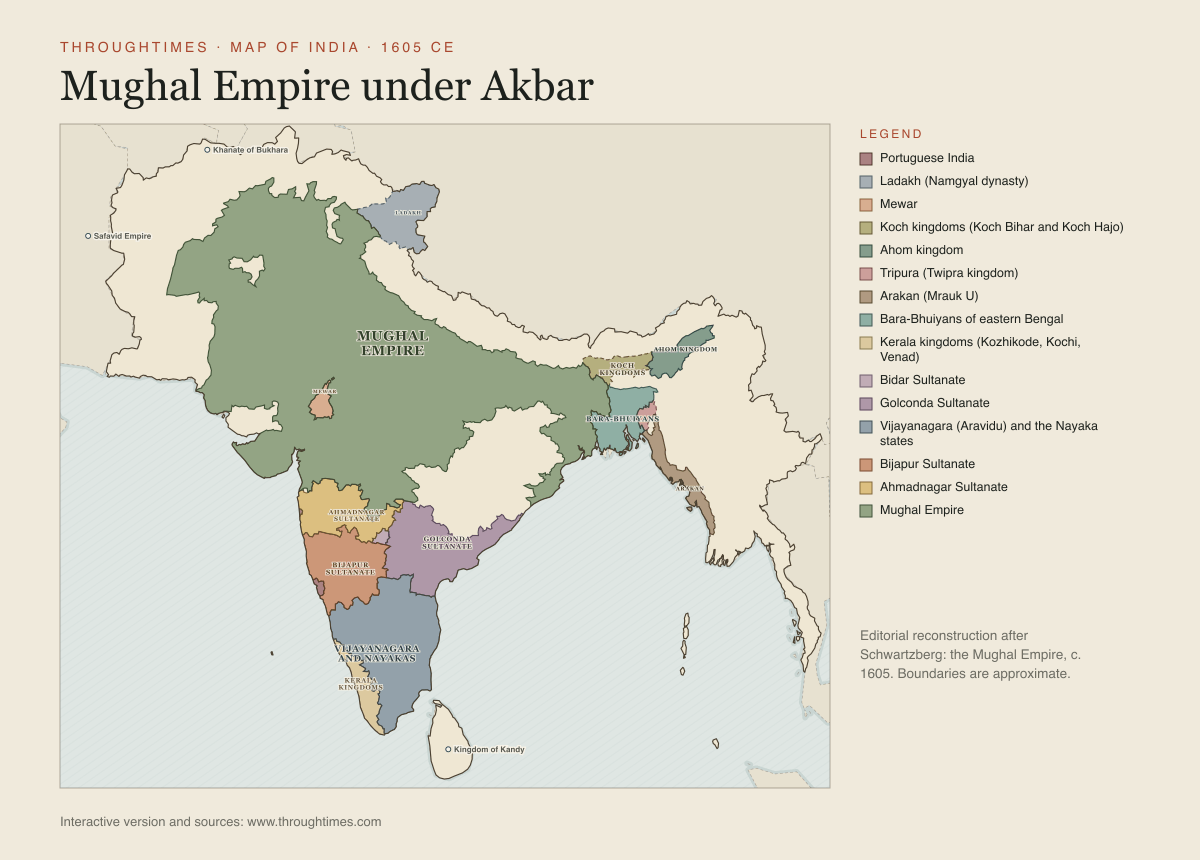
The Mughal Period at a glance
- When did the Mughal Empire start and end?
- 1526 to the 1670s in this atlas chapter. The empire itself lasted, much reduced after 1707, until 1857.
- Where was the Mughal Empire located?
- From Kabul and Lahore across the Ganga plain to Bengal, and later deep into the Deccan. Capitals included Agra, Fatehpur Sikri, Lahore and Delhi (Shahjahanabad).
- Who held power?
- Babur, Humayun, Akbar (1556–1605), Jahangir, Shah Jahan and Aurangzeb (from 1658), with Rajput, Persian and Central Asian nobles ranked as mansabdars. Sher Shah Suri interrupted Mughal rule from 1540 to 1555.
- How did people live?
- Land revenue assessed under Raja Todar Mal’s system, the silver rupee first issued by Sher Shah, and a vast trade in textiles, spices and indigo through ports such as Surat.
- What ideas and culture shaped it?
- Mughal architecture (Humayun’s Tomb, Fatehpur Sikri, the Taj Mahal, the Red Fort), miniature painting, Persian histories such as the Akbarnama, and Akbar’s ideal of sulh-i kul, “peace with all”.
- How did it end?
- From the 1660s Aurangzeb faced the Marathas, Sikhs and others. Shivaji Maharaj’s coronation in 1674 opens the next chapter, and after Aurangzeb’s death in 1707 the empire broke into regional states.
Timeline: how the Mughal era era unfolded
- 21 April 1526
Babur defeats Ibrahim Lodi at the First Battle of Panipat.
- 1540
Sher Shah Suri defeats Humayun and founds the Sur Empire.
- 1556
Akbar becomes emperor; the Second Battle of Panipat secures Mughal rule.
- 1565
The Deccan Sultanates defeat Vijayanagara at the Battle of Talikota.
- 1600
The English East India Company receives its royal charter in London.
- 1632
Shah Jahan begins building the Taj Mahal in Agra.
- 1658
Aurangzeb takes the throne after a war of succession.
The Mughal era era, year by year
78 years of this era have a page of their own in the atlas: what happened, who ruled, and the map.
- 1526 CE First Battle of Panipat
- 1527 CE Babur defeats Rana Sanga at Khanwa
- 1529 CE End of Krishnadevaraya’s reign
- 1530 CE Death of Babur
- 1531 CE Death of Vallabha
- 1533 CE Death of Chaitanya
- 1534 CE Humayun takes Mandu
- 1535 CE Portuguese fort at Diu
- 1537 CE Death of Bahadur Shah
- 1539 CE Sher Shah defeats Humayun at Chausa
- 1540 CE Sher Shah displaces Humayun
- 1542 CE Birth of Akbar
- 1543 CE Humayun flees to Iran
- 1545 CE Death of Sher Shah at Kalinjar
- 1546 CE Xavier’s Inquisition request
- 1547 CE Mirabai’s death at Dwarka
- 1552 CE Guru Amar Das succeeds
- 1553 CE End of Islam Shah’s reign
- 1555 CE Humayun briefly restores Mughal rule
- 1556 CE Akbar begins his reign
- 1559 CE Portuguese take Daman
- 1560 CE Akbar dismisses Bairam Khan
- 1561 CE Mughal conquest of Malwa
- 1562 CE Akbar’s Hamzanama begins
- 1563 CE Pilgrim tax abolished
- 1564 CE Akbar abolishes the jizya
- 1565 CE Battle of Talikota weakens Vijayanagara
- 1568 CE Fall of Chittor
- 1569 CE Fall of Ranthambhor
- 1570 CE Humayun’s Tomb completed
- 1571 CE Jami Masjid, Fatehpur Sikri
- 1572 CE Rana Pratap takes the throne
- 1573 CE Akbar conquers Gujarat
- 1574 CE Tulsidas’s Ramcharitmanas
- 1575 CE Battle of Tukaroi
- 1576 CE Battle of Haldighati
- 1577 CE Founding of Amritsar
- 1579 CE Akbar’s mahzar decree
- 1581 CE Ahoms annex Koch-Hajo
- 1585 CE Akbar moves to Lahore
- 1586 CE Mughals annex Kashmir
- 1591 CE Mughals annex Sindh
- 1595 CE Mughals take Kandahar
- 1596 CE Chand Bibi and Ahmadnagar
- 1598 CE Ain-i Akbari completed
- 1599 CE Death of Eknath
- 1600 CE Fall of Ahmadnagar
- 1601 CE Siege of Asirgarh
- 1602 CE Killing of Abul Fazl
- 1604 CE The Adi Granth compiled
- 1605 CE Jahangir succeeds Akbar
- 1606 CE Martyrdom of Guru Arjan
- 1609 CE Atiya mosque built
- 1610 CE Wadiyars take Srirangapatna
- 1611 CE Nur Jahan marries Jahangir
- 1612 CE Battle of Swally
- 1613 CE English factory at Surat
- 1614 CE Death of Venkata II
- 1615 CE Thomas Roe enters the Mughal court
- 1620 CE Mughals check Malik Ambar
- 1622 CE Kandahar lost; Khurram rebels
- 1623 CE Death of Tulsidas
- 1624 CE Death of Ahmad Sirhindi
- 1626 CE Mahabat Khan’s coup
- 1627 CE Death of Jahangir
- 1628 CE Shah Jahan takes the throne
- 1630 CE Lal Mahal and the Bhonsle household
- 1631 CE Death of Mumtaz Mahal
- 1632 CE Taj Mahal begun
- 1633 CE Fall of Daulatabad
- 1636 CE Deccan accord of 1636
- 1638 CE Bijapur takes Gingee
- 1639 CE Madras founded
- 1640 CE Who ruled, and the map
- 1641 CE Fort St George headquarters
- 1642 CE Death of Abdul Haqq Dehlavi
- 1643 CE Jahanara’s Ajmer pilgrimage
- 1644 CE Death of Guru Hargobind
Kingdoms and powers of this era
Dates are conventional estimates; several of these powers began before or lasted beyond this era.
- Mughal Empire (1526 CE–1857 CE). Northern India, and at its height most of the subcontinent. Founded by Babur after Panipat; nominal rule ended in 1857. Read: The Mughal Empire
- Sur Empire (1540 CE–1556 CE). Northern India. Sher Shah Suri displaced Humayun and reorganised revenue and roads.
- Deccan Sultanates (Ahmadnagar, Bijapur, Golconda, Berar, Bidar) (1490 CE–1687 CE). Deccan plateau. Successor states of the Bahmanis; the last, Golconda, fell to Aurangzeb in 1687.
- Vijayanagara Empire (1336 CE–1646 CE). Southern India; capital Vijayanagara (Hampi). The great southern empire whose capital at Hampi is a World Heritage Site.
- Mewar (Sisodia Rajputs) (1326 CE–1949 CE). Southern Rajasthan; capitals Chittor, later Udaipur. Rajput kingdom of Rana Kumbha, Rana Sanga and Maharana Pratap; a princely state under British paramountcy from 1818, merged into Rajasthan in 1949.
- Ahom kingdom (1228 CE–1826 CE). Brahmaputra valley, Assam. Ruled the Brahmaputra valley for six centuries until the Treaty of Yandabo.
मुग़ल काल: आसान भाषा में
1526 में बाबर ने पानीपत की पहली लड़ाई जीतकर मुग़ल साम्राज्य की नींव रखी। अकबर ने मज़बूत प्रशासन और धार्मिक सहिष्णुता की नीति अपनाई, और शाहजहाँ ने ताजमहल बनवाया। 1707 में औरंगज़ेब की मृत्यु के बाद साम्राज्य बिखरने लगा।
Mughal Samrajya 1526 mein Babur ne shuru kiya. Akbar, Jahangir, Shah Jahan aur Aurangzeb iske bade badshah the.
Sources & further reading
Original plain-language summary. Dates for early periods are scholarly estimates; the sources below give fuller detail.