Eras of Indian history · 1645–1818 CE
Maratha Swarajya and Expansion
Chhatrapati Shivaji Maharaj built an independent Maratha state, Swarajya, in the hills and coast of the western Deccan, using forts, a navy and fast-moving cavalry. After his death the Marathas survived a long war with Aurangzeb, then expanded across much of India under the Peshwas, until the British East India Company defeated them in 1818.
See 1674 CE on the map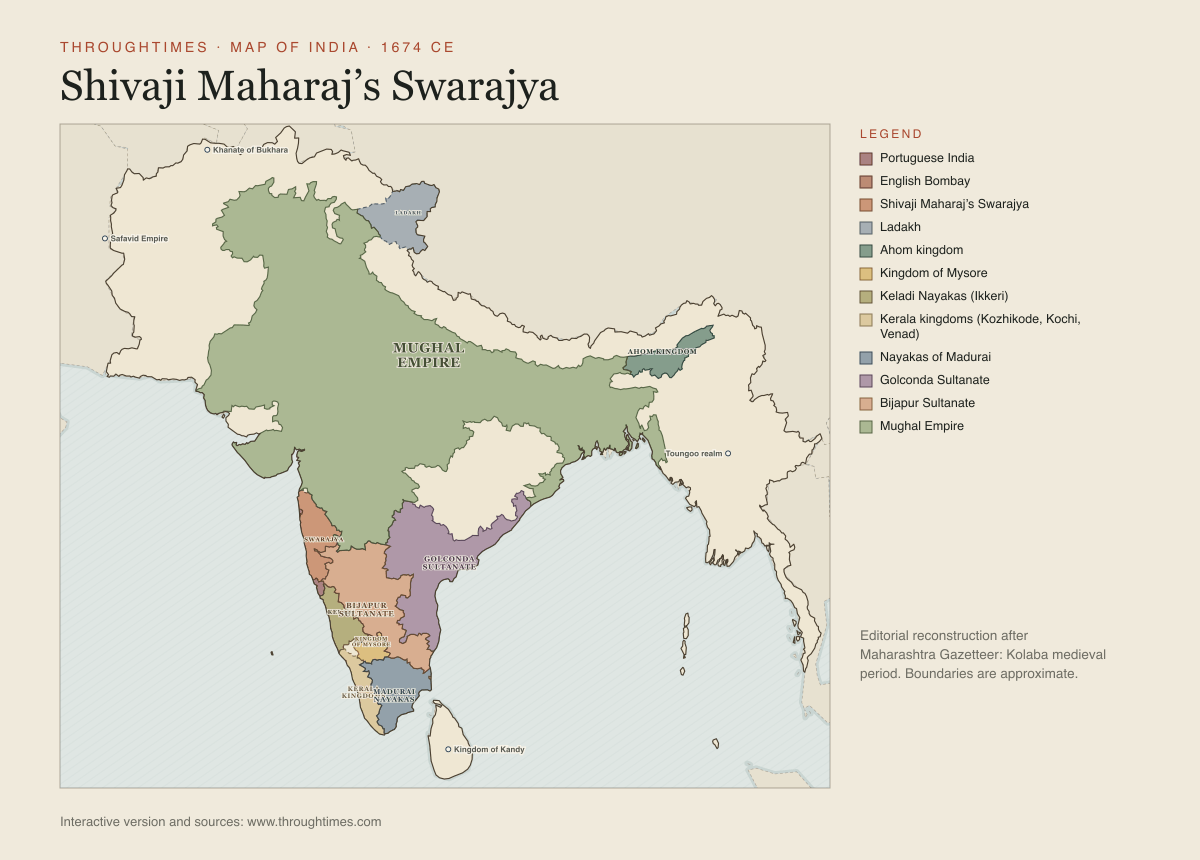
Maratha Swarajya and Expansion at a glance
- When did the Maratha period start and end?
- c. 1645–1818. Shivaji Maharaj was crowned Chhatrapati at Raigad in 1674.
- Where was the Maratha Empire located?
- Began in the Sahyadri hills (Western Ghats) and the Konkan coast around Pune. By the 1750s Maratha armies and tributaries reached from the Deccan to Delhi and Punjab, and from Gujarat to Odisha.
- Who held power?
- Shivaji Maharaj, Sambhaji, Rajaram and Tarabai; later the Peshwas at Pune and great houses such as the Scindias, Holkars, Gaekwads and the Bhonsles of Nagpur.
- How did people live?
- Revenue through chauth and sardeshmukhi levies, a network of hill and sea forts, and Kanhoji Angre’s navy guarding the Konkan coast.
- What ideas and culture shaped it?
- The Ashta Pradhan council of eight ministers, Marathi as a language of government, and the Bhakti tradition of Varkari saints such as Tukaram.
- How did it end?
- Defeat at the Third Battle of Panipat in 1761 checked northern expansion. After three Anglo-Maratha wars, the Peshwa surrendered to the British in 1818.
Timeline: how the Shivaji Maharaj era unfolded
- c. 1645–46
Young Shivaji begins securing forts around Pune, starting the Swarajya.
- 1659
Shivaji Maharaj defeats Afzal Khan of Bijapur at Pratapgad.
- 6 June 1674
Coronation at Raigad: Shivaji Maharaj becomes Chhatrapati.
- 1680
Shivaji Maharaj dies; the war with Aurangzeb continues under Sambhaji, Rajaram and Tarabai.
- 1707
Aurangzeb dies, and Maratha power begins to expand quickly.
- 1720
Bajirao I becomes Peshwa and leads campaigns into north India.
- 14 January 1761
Third Battle of Panipat: Ahmad Shah Durrani defeats the Maratha army.
- 1818
The Third Anglo-Maratha War ends and the Peshwa’s lands pass to the Company.
The Shivaji Maharaj era, year by year
69 years of this era have a page of their own in the atlas: what happened, who ruled, and the map.
- 1646 CE Torna becomes an early stronghold
- 1648 CE Shah Jahan enters the Red Fort
- 1649 CE Death of Tukaram
- 1651 CE English factory on the Hugli
- 1652 CE Madras becomes a presidency
- 1656 CE Jama Masjid of Delhi
- 1657 CE War of succession begins
- 1658 CE Battle of Samugarh
- 1659 CE Encounter at Pratapgad
- 1661 CE Guru Hari Krishen succeeds
- 1662 CE Mir Jumla invades Assam
- 1663 CE Raid on Shaista Khan’s camp at Pune
- 1664 CE Shivaji raids Surat
- 1665 CE Treaty of Purandar
- 1666 CE Shivaji Maharaj escapes confinement at Agra
- 1667 CE Ahom victory at Itakhuli
- 1668 CE French factory at Surat
- 1669 CE Battle of Alaboi
- 1670 CE Bernier’s Travels published
- 1671 CE Battle of Saraighat
- 1673 CE French arrive at Puducherry
- 1674 CE Shivaji Maharaj is crowned at Raigad
- 1675 CE Martyrdom of Guru Tegh Bahadur
- 1677 CE Shivaji takes Jinji
- 1679 CE Aurangzeb’s Marwar war
- 1680 CE Swarajya enters a succession struggle
- 1681 CE Prince Akbar’s revolt
- 1686 CE Mughals capture Bijapur
- 1687 CE Golconda falls to Mughal forces
- 1689 CE Execution of Sambhaji
- 1690 CE Siege of Jinji begins
- 1693 CE Dutch take Puducherry
- 1696 CE English fort in Bengal
- 1698 CE Fall of Jinji
- 1699 CE Founding of the Khalsa
- 1700 CE Death of Rajaram
- 1704 CE Murshidabad becomes Bengal’s capital
- 1707 CE Long Mughal-Maratha war reaches a turn
- 1708 CE Guru Gobind Singh dies
- 1710 CE Sikhs capture Sirhind
- 1712 CE Death of Bahadur Shah I
- 1713 CE Farrukh-Siyar becomes emperor
- 1715 CE Fall of Gurdas Nangal
- 1716 CE Execution of Banda Singh
- 1717 CE Farrukh-Siyar’s farman to the Company
- 1719 CE Farrukh-Siyar deposed
- 1720 CE Baji Rao I becomes peshwa
- 1722 CE Bharatpur recognised as autonomous
- 1723 CE Bhopal state founded
- 1724 CE Hyderabad state founded
- 1727 CE Jaipur founded
- 1729 CE Martanda Varma takes the throne
- 1733 CE Bharatpur city founded
- 1737 CE Maratha raid on Delhi
- 1739 CE Nadir Shah sacks Delhi
- 1740 CE Balaji Baji Rao becomes Peshwa
- 1741 CE Battle of Colachel
- 1742 CE Maratha raids on Bengal
- 1743 CE Death of Sawai Jai Singh II
- 1746 CE French capture Madras
- 1747 CE Rise of Ahmad Shah Durrani
- 1748 CE Madras returned to the English
- 1749 CE Death of Shahu
- 1750 CE Travancore given to Padmanabha
- 1751 CE Clive at Arcot
- 1752 CE Defeat of Chanda Sahib
- 1753 CE Suraj Mal raids Delhi
- 1754 CE Dupleix recalled
- 1756 CE Siraj-ud-Daulah takes Calcutta
Kingdoms and powers of this era
Dates are conventional estimates; several of these powers began before or lasted beyond this era.
- Maratha Swarajya and Empire (1674 CE–1818 CE). Western Deccan, later much of central and northern India. From Shivaji Maharaj's coronation in 1674 to the Third Anglo-Maratha War. Read: Maratha Swarajya and Expansion
- Mughal Empire (1526 CE–1857 CE). Northern India, and at its height most of the subcontinent. Founded by Babur after Panipat; nominal rule ended in 1857. Read: The Mughal Empire
- Kingdom of Mysore (1610 CE–1950 CE). Southern Karnataka. Wodeyar kingdom, independent of Vijayanagara from about 1610; under Hyder Ali and Tipu Sultan from 1761 to 1799.
- Hyderabad State (Nizams) (1724 CE–1948 CE). Deccan; capital Hyderabad. Asaf Jahi Nizams, the most populous princely state, integrated into India in 1948.
मराठा स्वराज्य और विस्तार: आसान भाषा में
छत्रपति शिवाजी महाराज ने सह्याद्री के किलों, नौसेना और तेज़ घुड़सवार सेना के बल पर स्वराज्य की स्थापना की और 1674 में रायगढ़ में उनका राज्याभिषेक हुआ। बाद में पेशवाओं के समय मराठा शक्ति भारत के बड़े हिस्से में फैली, और 1818 में अंग्रेज़ों से हार के साथ यह दौर समाप्त हुआ।
Maratha Swarajya Shivaji Maharaj ne banaya; 1674 mein Raigad par rajyabhishek hua. Peshwaon ke samay Maratha shakti poore Bharat mein faili.
Sources & further reading
Original plain-language summary. Dates for early periods are scholarly estimates; the sources below give fuller detail.