Eras of Indian history · 1206–1526 CE
The Sultanate Period
For three centuries, five dynasties of Turkic and Afghan origin ruled from Delhi: the Mamluks (the “Slave dynasty”), Khaljis, Tughluqs, Sayyids and Lodis. They held off Mongol invasions and at times reached far into the south, while powerful states such as the Vijayanagara Empire and the Bahmani Sultanate rose in the Deccan.
See 1320 CE on the map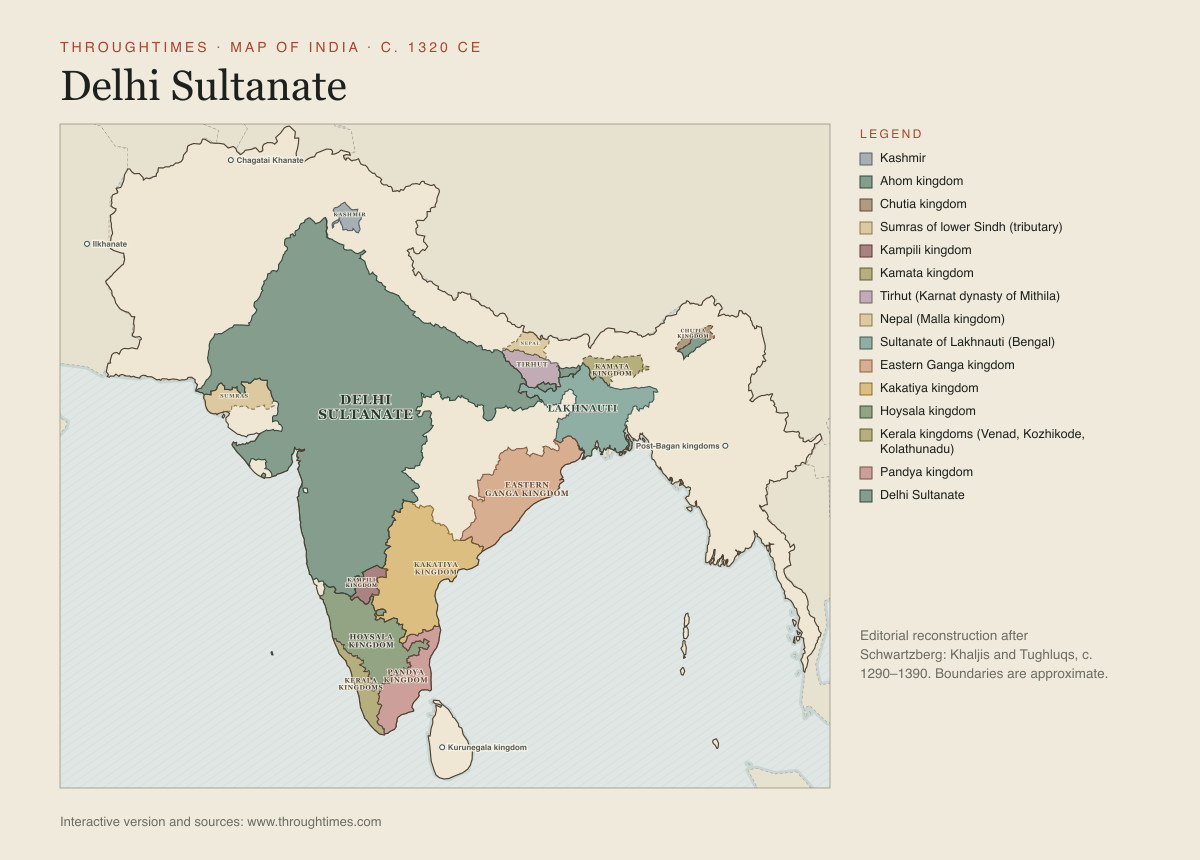
The Sultanate Period at a glance
- When did the Delhi Sultanate start and end?
- 1206–1526.
- Where was the Delhi Sultanate located?
- Centred on Delhi and the Ganga plain. At its widest, under Muhammad bin Tughluq in the 1330s, it reached deep into the south.
- Who held power?
- Mamluk (1206–1290), Khalji (1290–1320), Tughluq (1320–1414), Sayyid (1414–1451) and Lodi (1451–1526) dynasties. Notable rulers include Iltutmish, Razia Sultan, Alauddin Khalji and Firuz Shah Tughluq.
- How did people live?
- Iqta assignments paid nobles and soldiers from land revenue, Delhi grew into one of the great cities of the Islamic world, and long-distance trade and crafts expanded.
- What ideas and culture shaped it?
- Indo-Islamic architecture such as the Qutb Minar, Sufi orders such as the Chishtis, Amir Khusrau’s poetry and music, and Bhakti saints such as Kabir and Ravidas.
- How did it end?
- Babur of Kabul defeated Ibrahim Lodi at the First Battle of Panipat on 21 April 1526 and founded Mughal rule.
Timeline: how the Sultanate era unfolded
- 1206
Qutb-ud-din Aibak founds the Delhi Sultanate.
- 1236
Razia Sultan takes the throne, the only woman to rule the Delhi Sultanate.
- 1296
Alauddin Khalji becomes sultan; his armies repel Mongol attacks and campaign in the Deccan.
- 1327
Muhammad bin Tughluq moves his capital to Daulatabad in the Deccan, a move he soon reverses.
- 1336
Harihara and Bukka found the Vijayanagara Empire in the south.
- 1347
The Bahmani Sultanate is founded in the Deccan.
- 1398
Timur invades and sacks Delhi.
- 1451
Bahlul Lodi founds the Lodi dynasty, the last of the five.
The Sultanate era, year by year
103 years of this era have a page of their own in the atlas: what happened, who ruled, and the map.
- 1206 CE Delhi Sultanate is founded
- 1210 CE Iltutmish secures the Delhi throne
- 1216 CE Iltutmish defeats Yildiz
- 1221 CE Mongol pressure reaches the northwest
- 1228 CE Ahom arrive in Assam
- 1229 CE Caliph recognises Iltutmish
- 1230 CE Odisha dedicated to Jagannatha
- 1235 CE Death of Muinuddin Chishti
- 1236 CE Razia claims the sultan’s office
- 1238 CE Birth of Madhvacharya
- 1240 CE Raziyya is deposed
- 1241 CE Mongols sack Lahore
- 1246 CE Nasir al-Din Mahmud enthroned
- 1250 CE Konark Sun Temple built
- 1251 CE Pandya power at its height
- 1253 CE Birth of Amir Khusrau
- 1262 CE Rudramadevi rules Warangal
- 1265 CE Death of Baba Farid
- 1266 CE Balban begins his reign
- 1270 CE Birth of Namdev
- 1285 CE Balban’s heir killed by Mongols
- 1287 CE Death of Balban
- 1289 CE Khusrau’s Qiran al-Sadain
- 1290 CE Khalji dynasty begins
- 1292 CE Marco Polo in south India
- 1296 CE Alauddin Khalji takes power
- 1297 CE Khaljis conquer Gujarat
- 1299 CE Battle of Kili
- 1301 CE Fall of Ranthambhor
- 1303 CE Siege of Chittor
- 1305 CE Khaljis conquer Malwa
- 1309 CE Malik Kafur at Warangal
- 1311 CE Malik Kafur raids the far south
- 1313 CE Nizamuddin’s sayings recorded
- 1316 CE Death of Alauddin Khalji
- 1320 CE Tughluq dynasty begins
- 1323 CE Fall of Warangal
- 1325 CE Nizamuddin and Khusrau die
- 1326 CE Second sack of Dorasamudra
- 1327 CE Court moves toward Daulatabad
- 1329 CE Token currency introduced
- 1333 CE Ibn Battuta arrives at Delhi
- 1335 CE Madurai sultanate founded
- 1336 CE Vijayanagara is founded
- 1342 CE Ibn Battuta sent to China
- 1343 CE Death of Ballala III
- 1345 CE Deccan nobles revolt
- 1346 CE End of the Hoysalas
- 1347 CE Bahmani Sultanate emerges
- 1351 CE Firuz Shah Tughluq succeeds
- 1352 CE Ilyas Shah unites Bengal
- 1353 CE Firuz Shah’s Bengal campaign
- 1354 CE Hisar founded
- 1356 CE Death of Chiragh-i Dehli
- 1359 CE Jaunpur founded
- 1360 CE Firuz Shah raids Orissa
- 1369 CE Adina Mosque at Pandua
- 1387 CE Death of Sayana
- 1388 CE Death of Firuz Shah Tughluq
- 1394 CE Sharqi sultanate of Jaunpur
- 1395 CE Khanqah of Shah Hamadan
- 1398 CE Timur sacks Delhi
- 1399 CE Who ruled, and the map
- 1401 CE Malwa breaks from Delhi
- 1405 CE Zheng He sails to Calicut
- 1408 CE Atala Mosque, Jaunpur
- 1411 CE Ahmedabad founded
- 1414 CE Sayyid dynasty begins
- 1420 CE Zayn-ul-Abidin rules Kashmir
- 1425 CE Bahmanis annex Telangana
- 1435 CE Gajapati kingdom founded
- 1440 CE Birth of Kabir
- 1451 CE Lodi dynasty begins
- 1459 CE Jodhpur founded
- 1466 CE Mahmud Gawan’s vizierate
- 1469 CE Birth of Guru Nanak
- 1479 CE Lodis annex Jaunpur
- 1481 CE Execution of Mahmud Gawan
- 1485 CE Saluva dynasty at Vijayanagara
- 1486 CE Birth of Chaitanya
- 1488 CE Bikaner founded
- 1489 CE Sikandar Lodi’s accession
- 1490 CE Deccan sultanates emerge
- 1493 CE Husain Shah rules Bengal
- 1494 CE Ahmadnagar city founded
- 1498 CE Vasco da Gama reaches Calicut
- 1500 CE Cabral at Calicut
- 1502 CE Vasco da Gama’s second voyage
- 1503 CE Tuluva dynasty at Vijayanagara
- 1504 CE Sikandar Lodi founds Agra
- 1505 CE First Portuguese viceroy
- 1508 CE Battle of Chaul
- 1509 CE Krishnadeva Raya crowned
- 1510 CE Portuguese conquest of Goa
- 1512 CE Vijayanagara takes Raichur doab
- 1514 CE Vijayanagara defeats Orissa
- 1515 CE Death of Albuquerque
- 1517 CE Ibrahim Lodi’s accession
- 1518 CE Golconda sultanate emerges
- 1520 CE Battle of Raichur
- 1523 CE Ahoms annex the Chutiyas
- 1524 CE Death of Vasco da Gama
- 1525 CE Babur’s final invasion
Kingdoms and powers of this era
Dates are conventional estimates; several of these powers began before or lasted beyond this era.
- Delhi Sultanate (1206 CE–1526 CE). Northern India from Delhi; at times much of the subcontinent. Five successive houses ruled from Delhi until Babur's victory at Panipat. Read: The Delhi Sultanate
- Vijayanagara Empire (1336 CE–1646 CE). Southern India; capital Vijayanagara (Hampi). The great southern empire whose capital at Hampi is a World Heritage Site.
- Bahmani Sultanate (1347 CE–1527 CE). Deccan; capitals Gulbarga and Bidar. Deccan sultanate that later split into five successor states.
- Bengal Sultanate (1352 CE–1576 CE). Bengal. Independent sultanate of Bengal, absorbed by the Mughals.
- Ahom kingdom (1228 CE–1826 CE). Brahmaputra valley, Assam. Ruled the Brahmaputra valley for six centuries until the Treaty of Yandabo.
- Mewar (Sisodia Rajputs) (1326 CE–1949 CE). Southern Rajasthan; capitals Chittor, later Udaipur. Rajput kingdom of Rana Kumbha, Rana Sanga and Maharana Pratap; a princely state under British paramountcy from 1818, merged into Rajasthan in 1949.
सल्तनत काल: आसान भाषा में
1206 से 1526 तक दिल्ली पर पाँच वंशों ने शासन किया: मामलूक (गुलाम वंश), खिलजी, तुगलक, सैयद और लोदी। इसी समय दक्षिण में विजयनगर साम्राज्य और बहमनी सल्तनत का उदय हुआ।
Delhi Saltanat 1206 se 1526 tak. Gulam vansh, Khilji, Tughlaq, Sayyid aur Lodi; dakshin mein Vijayanagar aur Bahmani.
Sources & further reading
Original plain-language summary. Dates for early periods are scholarly estimates; the sources below give fuller detail.