Eras of Indian history · 1757–1885 CE
Company Rule in India
The English East India Company came to India to trade, but after winning the Battle of Plassey in 1757 it began to rule. Using armies, alliances and land revenue, it took control of most of the subcontinent within a century. After the great revolt of 1857, the British Crown took over direct rule in 1858.
See 1793 CE on the map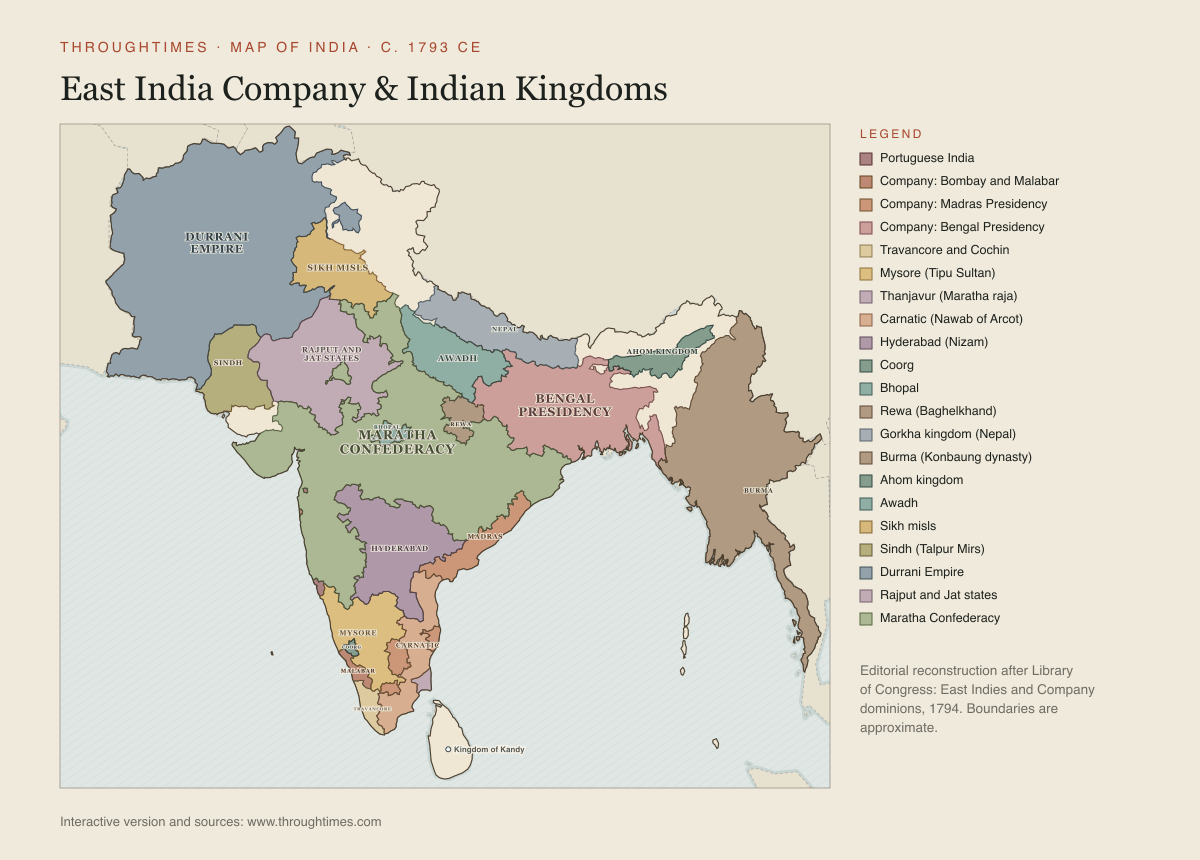
Company Rule in India at a glance
- When did Company rule in India start and end?
- 1757–1858 for Company rule itself. This atlas chapter runs to 1885 to show the first decades of Crown rule.
- Where did the East India Company rule?
- Spreading out from Bengal. Calcutta was the capital, with Bombay and Madras as the other presidencies; many princely states stayed under indirect control.
- Who held power?
- Company Governors-General such as Warren Hastings, Cornwallis, Wellesley and Dalhousie; after 1858 a Viceroy representing the British Crown.
- How did people live?
- Heavy land-revenue settlements (the Permanent Settlement of 1793 and the Ryotwari system), the decline of Indian textile exports, and the arrival of railways (1853) and the telegraph.
- What ideas and culture shaped it?
- English-language education, print and newspapers, and reformers such as Raja Ram Mohan Roy and Ishwar Chandra Vidyasagar; sati was banned in 1829.
- How did it end?
- The Revolt of 1857 led the British Parliament to end Company rule through the Government of India Act 1858.
Timeline: how the Company rule era unfolded
- 23 June 1757
Battle of Plassey: Robert Clive defeats Siraj-ud-Daulah, Nawab of Bengal.
- 1765
After the Battle of Buxar, the Company gains the diwani (revenue rights) of Bengal, Bihar and Odisha.
- 1793
The Permanent Settlement fixes land revenue in Bengal.
- 1799
Tipu Sultan dies defending Seringapatam in the Fourth Anglo-Mysore War.
- 1829
Governor-General William Bentinck bans sati.
- 16 April 1853
India’s first passenger train runs from Bombay to Thane.
- 10 May 1857
The Revolt of 1857 breaks out at Meerut.
- 1858
The Government of India Act ends Company rule; the Crown takes over.
The Company rule era, year by year
81 years of this era have a page of their own in the atlas: what happened, who ruled, and the map.
- 1757 CE Battle of Plassey
- 1758 CE Lally besieges Madras
- 1759 CE Shah Alam II proclaimed emperor
- 1760 CE Battle of Wandiwash
- 1761 CE Third Battle of Panipat
- 1762 CE Birth of Syama Sastri
- 1763 CE Mir Qasim’s war with the Company
- 1764 CE Battle of Buxar
- 1765 CE Company receives the Diwani
- 1766 CE Waris Shah’s Hir
- 1767 CE First Anglo-Mysore War begins
- 1768 CE Gorkha conquest of Kathmandu
- 1769 CE Treaty of Madras
- 1770 CE Great Bengal famine devastates the region
- 1772 CE Warren Hastings in charge of Bengal
- 1773 CE Regulating Act reshapes Company rule
- 1774 CE The Rohilla War
- 1775 CE First Anglo-Maratha War
- 1776 CE Treaty of Purandhar
- 1778 CE First book in Bengali type
- 1779 CE Convention of Wadgaon
- 1780 CE Hicky’s Bengal Gazette
- 1781 CE Battle of Porto Novo
- 1782 CE Treaty of Salbai
- 1783 CE William Jones reaches Calcutta
- 1784 CE Pitt’s India Act strengthens state oversight
- 1785 CE Hastings leaves India
- 1786 CE Cornwallis becomes governor-general
- 1788 CE Impeachment of Warren Hastings
- 1790 CE Third Anglo-Mysore War
- 1792 CE Treaty of Seringapatam
- 1793 CE Permanent Settlement in Bengal
- 1794 CE Death of Mahadji Scindia
- 1795 CE Nizam loses territory to the Marathas
- 1796 CE Baji Rao II becomes peshwa
- 1798 CE Wellesley’s subsidiary alliances
- 1799 CE Tipu Sultan falls at Srirangapatna
- 1800 CE Death of Nana Fadnavis
- 1801 CE Ranjit Singh becomes Maharaja
- 1802 CE Treaty of Bassein divides Maratha politics
- 1803 CE Battle of Assaye
- 1804 CE Holkar fights the Company
- 1805 CE Siege of Bharatpur
- 1806 CE Vellore Mutiny
- 1807 CE Lord Minto becomes governor-general
- 1808 CE Elphinstone mission to Shah Shuja
- 1809 CE Treaty of Amritsar (1809)
- 1813 CE Charter Act of 1813
- 1814 CE Anglo-Nepalese War begins
- 1815 CE Ram Mohan Roy’s Atmiya Sabha
- 1816 CE Treaty of Segauli
- 1817 CE Hindu College founded
- 1818 CE Company defeats the Peshwa
- 1819 CE Sikhs annex Kashmir
- 1820 CE Ishwar Chandra Vidyasagar born
- 1824 CE Barrackpore Mutiny
- 1825 CE Dadabhai Naoroji born
- 1826 CE Treaty of Yandabo
- 1827 CE Jyotirao Phule born
- 1828 CE Brahmo Samaj founded
- 1829 CE Sati abolished
- 1830 CE Ram Mohan Roy goes to England
- 1831 CE British take over Mysore
- 1833 CE Charter Act of 1833
- 1834 CE Coorg annexed
- 1835 CE English education resolution
- 1836 CE Ramakrishna born
- 1837 CE Bahadur Shah II accedes
- 1838 CE Assam joined to Bengal
- 1839 CE Death of Ranjit Singh
- 1842 CE Retreat from Kabul
- 1843 CE Conquest of Sindh
- 1845 CE First Anglo-Sikh War
- 1846 CE Gulab Singh gets Kashmir
- 1848 CE Phules’ girls’ school in Pune
- 1849 CE Punjab annexed
- 1852 CE Second Anglo-Burmese War
- 1853 CE Jhansi annexed by lapse
- 1854 CE Wood’s Dispatch on education
- 1855 CE Santhal rebellion
- 1856 CE Annexation of Awadh
Kingdoms and powers of this era
Dates are conventional estimates; several of these powers began before or lasted beyond this era.
- East India Company rule (1757 CE–1858 CE). Bengal from 1757, expanding across the subcontinent. A trading company turned territorial power after Plassey, until the Crown took over in 1858. Read: The Battle of Plassey
- Nawabs of Bengal (1717 CE–1757 CE). Bengal, Bihar and Odisha; capital Murshidabad. Autonomous Mughal governors until Plassey in 1757. Read: The Battle of Plassey
- Kingdom of Mysore (1610 CE–1950 CE). Southern Karnataka. Wodeyar kingdom, independent of Vijayanagara from about 1610; under Hyder Ali and Tipu Sultan from 1761 to 1799.
- Sikh Empire (1799 CE–1849 CE). Punjab; capital Lahore. Founded by Maharaja Ranjit Singh; annexed by the British in 1849.
- Awadh (1722 CE–1856 CE). Central Uttar Pradesh; capitals Faizabad and Lucknow. Nawabi state annexed by the East India Company in 1856.
- Hyderabad State (Nizams) (1724 CE–1948 CE). Deccan; capital Hyderabad. Asaf Jahi Nizams, the most populous princely state, integrated into India in 1948.
कंपनी राज: आसान भाषा में
ईस्ट इंडिया कंपनी व्यापार के लिए भारत आई थी, लेकिन 1757 में प्लासी की लड़ाई जीतने के बाद उसने शासन करना शुरू कर दिया। सौ वर्षों में उसने उपमहाद्वीप के अधिकांश भाग पर नियंत्रण कर लिया, और 1857 के विद्रोह के बाद 1858 में ब्रिटिश ताज ने सीधा शासन संभाल लिया।
Company Raj 1757 mein Plassey ki ladai ke baad shuru hua aur 1858 mein khatam hua, jab British Crown ne seedha shasan sambhala.
Sources & further reading
Original plain-language summary. Dates for early periods are scholarly estimates; the sources below give fuller detail.