Eras of Indian history · 550–1206 CE
Regional Kingdoms of Early Medieval India
After the Guptas, no single power held north India for long. Strong regional kingdoms such as the Chalukyas, Pallavas, Rashtrakutas, Palas, Pratiharas and Cholas competed for land and prestige, built great temples and traded across the Indian Ocean. Towards the end, conquests from the north-west led to the founding of the Delhi Sultanate.
See 850 CE on the map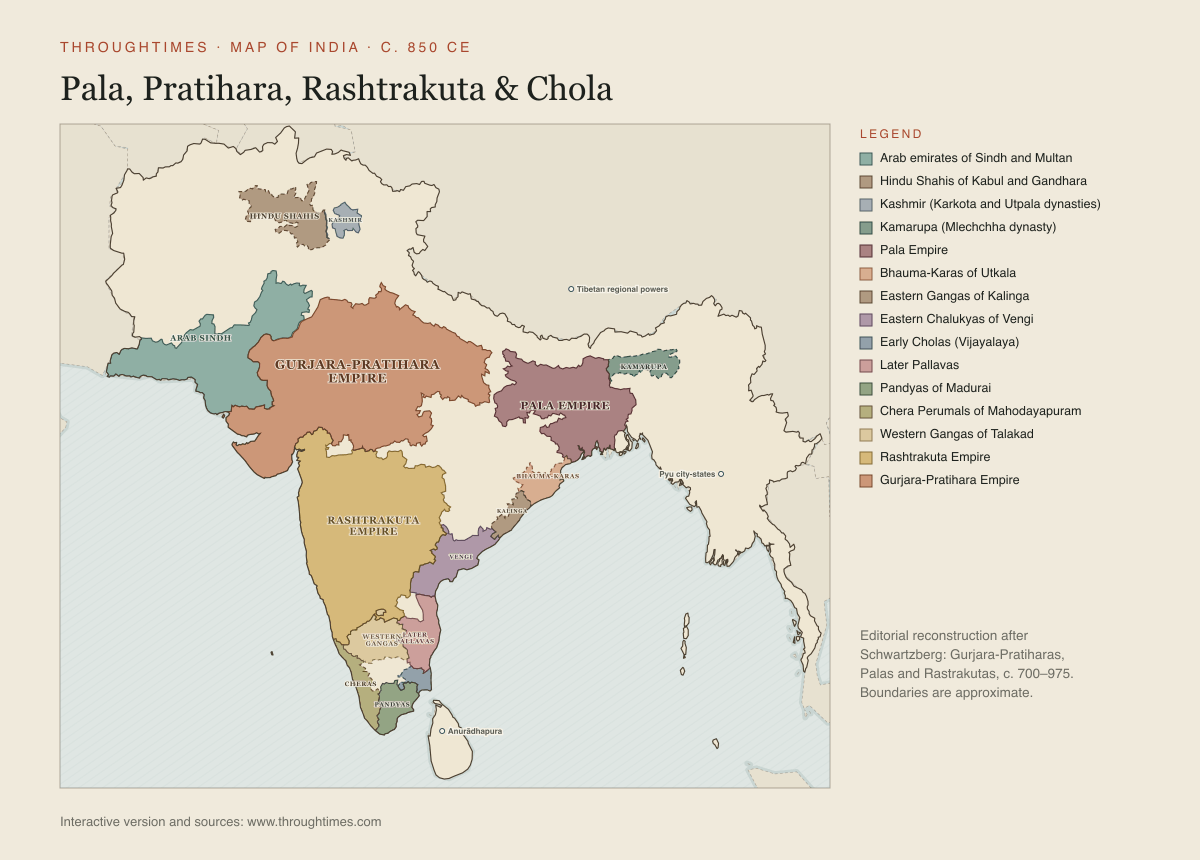
Regional Kingdoms of Early Medieval India at a glance
- When was early medieval India?
- c. 550–1206 CE, often called early medieval India.
- Where were the regional kingdoms of early medieval India?
- Across the subcontinent: Kannauj in the north, Bengal and Bihar in the east, the Deccan plateau, and the Tamil coast.
- Who held power?
- Harsha of Kannauj; the Chalukyas of Badami and Pallavas of Kanchi; the Palas, Gurjara-Pratiharas and Rashtrakutas, who fought a long “tripartite struggle” for Kannauj; then the Cholas and Rajput clans such as the Chauhans.
- How did people live?
- Land grants to temples and Brahmins spread farming into new areas, temple towns became economic centres, and merchants traded with South-east Asia, China and the Arab world.
- What ideas and culture shaped it?
- Temple architecture at Mahabalipuram, Ellora’s Kailasa temple, Khajuraho and Thanjavur; Bhakti poetry of the Tamil Alvars and Nayanars; Shankaracharya’s philosophy; and the Buddhist monastery-university at Nalanda.
- How did it end?
- Muhammad of Ghor defeated Prithviraj Chauhan at the Second Battle of Tarain in 1192. In 1206 his general Qutb-ud-din Aibak took charge of the Indian conquests, founding the Delhi Sultanate.
Still debated. Several dates in this period, including Shankaracharya’s and the exact year of Pulakeshin II’s victory over Harsha, are estimates.
Timeline: how the Regional kingdoms era unfolded
- 606 CE
Harsha becomes king and later rules from Kannauj; the Chinese pilgrim Xuanzang visits his court.
- c. 620 CE
The Chalukya king Pulakeshin II stops Harsha’s advance on the Narmada river.
- 712 CE
Muhammad bin Qasim’s Arab army conquers Sindh.
- c. 750 CE
Gopala founds the Pala dynasty in Bengal.
- c. 1010 CE
Rajaraja Chola completes the Brihadisvara temple at Thanjavur.
- c. 1025 CE
Rajendra Chola’s navy raids the Srivijaya kingdom in South-east Asia.
- 1192 CE
Second Battle of Tarain: Muhammad of Ghor defeats Prithviraj Chauhan.
The Regional kingdoms era, year by year
87 years of this era have a page of their own in the atlas: what happened, who ruled, and the map.
- 550 CE Ravana Phadi cave, Aihole
- 600 CE Mahendravarman I of Kanchi
- 606 CE Harsha takes power at Thanesar
- 610 CE Pulakeshin II’s reign begins
- 624 CE Eastern Chalukyas of Vengi
- 628 CE Brahmagupta’s rules for zero
- 629 CE Xuanzang’s journey begins
- 630 CE Harsha and Pulakeshin II clash
- 634 CE Aihole inscription of 634
- 642 CE Pallavas capture Vatapi
- 643 CE Xuanzang leaves India
- 647 CE Death of Harsha
- 650 CE The rathas of Mamallapuram
- 671 CE Yijing sails for India
- 697 CE Sangamesvara temple, Pattadakal
- 700 CE Shore Temple, Mamallapuram
- 701 CE Palas, Pratiharas and Rashtrakutas contest Kannauj
- 712 CE Arab forces conquer Sindh
- 724 CE Lalitaditya of Kashmir
- 733 CE Virupaksha temple, Pattadakal
- 750 CE Pala and Rashtrakuta power expands
- 753 CE Rise of the Rashtrakutas
- 757 CE Kailasa temple, Ellora
- 770 CE Dharmapala of the Palas
- 783 CE Vikramashila founded
- 788 CE Advaita traditions associate with Shankara
- 810 CE Devapala of the Palas
- 812 CE Copper plate praises Kailasa
- 814 CE Amoghavarsha I
- 836 CE Mihira Bhoja
- 850 CE Regional courts contest Kannauj
- 855 CE Utpala dynasty of Kashmir
- 907 CE Parantaka I’s Chola reign
- 930 CE Who ruled, and the map
- 939 CE Krishna III Rashtrakuta
- 945 CE Images of the Nayanar saints
- 950 CE Khajuraho temples begin
- 954 CE Lakshmana temple, Khajuraho
- 973 CE Chalukyas of Kalyani
- 980 CE Queen Didda rules Kashmir
- 985 CE Rajaraja Chola begins his reign
- 1000 CE Who ruled, and the map
- 1001 CE Mahmud defeats Jaipal
- 1003 CE Lohara dynasty in Kashmir
- 1006 CE Rise of the Hoysalas
- 1010 CE Brihadisvara temple, Thanjavur
- 1014 CE Rajendra Chola projects maritime power
- 1017 CE Al-Biruni and the Kitab-ul-Hind
- 1018 CE Mahmud takes Kannauj
- 1023 CE Chola expedition to the Ganga
- 1025 CE Mahmud’s raid on Somnath
- 1026 CE Modhera Sun temple
- 1030 CE Death of Mahmud of Ghazni
- 1035 CE Gangaikondacholapuram temple
- 1039 CE Al-Hujwiri settles in Lahore
- 1042 CE Atisha goes to Tibet
- 1070 CE Kulottunga I unites two crowns
- 1078 CE Anantavarman Chodaganga
- 1099 CE Founding of Melkote
- 1100 CE The Dayabhaga law code
- 1110 CE Vishnuvardhana Hoysala
- 1114 CE Birth of Bhaskara II
- 1117 CE Chennakeshava temple, Belur
- 1121 CE Hoysaleshvara temple, Halebid
- 1130 CE Who ruled, and the map
- 1137 CE Death of Ramanuja
- 1143 CE Airavatesvara temple, Darasuram
- 1148 CE Kalhana’s Rajatarangini
- 1154 CE Al-Idrisi’s map of India
- 1156 CE Bijjala seizes Kalyani
- 1161 CE End of Pala rule
- 1162 CE Thousand Pillar Temple
- 1165 CE Chauhans take Delhi
- 1168 CE Basavanna and the Lingayats
- 1175 CE Ghurids take Multan
- 1178 CE Lakshmanasena and Jayadeva
- 1180 CE Who ruled, and the map
- 1181 CE Kalachuri rule ends
- 1186 CE Ghurids annex Lahore
- 1191 CE First Battle of Tarain
- 1192 CE Second Battle of Tarain
- 1194 CE Battle of Chandawar
- 1198 CE Quwwat-ul-Islam mosque
- 1199 CE Qutb Minar begun
- 1200 CE Sack of Nalanda
- 1202 CE Bakhtiyar Khalji takes Nadia
- 1205 CE Death of Lakshmanasena
Kingdoms and powers of this era
Dates are conventional estimates; several of these powers began before or lasted beyond this era.
- Harsha's kingdom (Pushyabhuti dynasty) (606 CE–647 CE). Northern India; capital Kannauj. Harshavardhana ruled much of northern India from Kannauj.
- Chalukyas of Badami (543 CE–753 CE). Karnataka and the Deccan. Deccan dynasty whose king Pulakeshin II checked Harsha's southward advance.
- Pallava dynasty (275 CE–897 CE). Tamil Nadu and southern Andhra; capital Kanchipuram. Builders of the Shore Temple and rock-cut monuments of Mamallapuram.
- Rashtrakuta dynasty (753 CE–982 CE). Deccan; capital Manyakheta. Builders of the Kailasa temple at Ellora.
- Pala Empire (750 CE–1161 CE). Bengal and Bihar. Buddhist patrons of Nalanda and Vikramashila.
- Gurjara-Pratihara dynasty (730 CE–1036 CE). Rajasthan, Gujarat and the Ganga plain; capital Kannauj. One of the three powers of the 'tripartite struggle' for Kannauj.
- Chola Empire (850 CE–1279 CE). Tamil Nadu, with naval reach to Sri Lanka and Southeast Asia. Imperial Cholas of Thanjavur, including Rajaraja I and Rajendra I. Read: The Chola Dynasty
क्षेत्रीय राजवंश (प्रारंभिक मध्यकालीन भारत): आसान भाषा में
गुप्तों के बाद (लगभग 550–1206 ई.) हर्ष, चालुक्य, पल्लव, राष्ट्रकूट, पाल, प्रतिहार और चोल जैसे क्षेत्रीय राजवंशों ने सत्ता के लिए संघर्ष किया और भव्य मंदिर बनवाए। 1192 में तराइन के दूसरे युद्ध के बाद दिल्ली सल्तनत का रास्ता खुला।
Kshetriya Rajvansh lagbhag 550 se 1206 CE tak. Harsha, Chalukya, Pallav, Rashtrakut, Pal aur Chola rajyon ne bade mandir banwaye.
Sources & further reading
Original plain-language summary. Dates for early periods are scholarly estimates; the sources below give fuller detail.