Eras of Indian history · 185 BCE–550 CE
Classical India and the Gupta Age
After the Mauryas, India was shared by many powers: the Shungas, Indo-Greeks and later the Kushanas in the north, the Satavahanas in the Deccan, and the Chera, Chola and Pandya kingdoms in the Tamil south. From 320 CE the Gupta dynasty united much of north India, in an age remembered for advances in mathematics, astronomy, literature and art.
See 375 CE on the map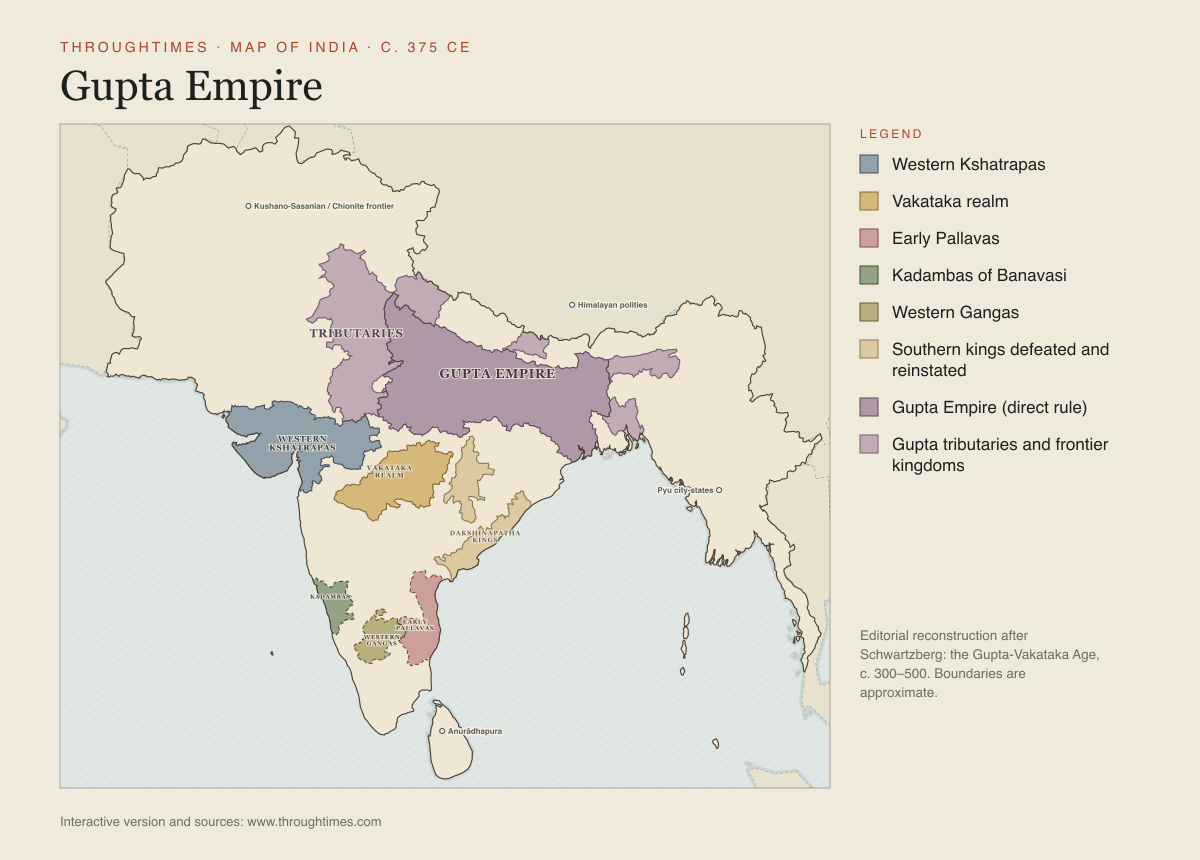
Classical India and the Gupta Age at a glance
- When was the classical age of India?
- c. 185 BCE–550 CE.
- Where were the Gupta Empire and the other classical kingdoms?
- The whole subcontinent, with power divided between the north, the Deccan and the Tamil south. The Gupta heartland was the Ganga plain.
- Who held power?
- Shungas, Indo-Greeks, Shakas and Kushanas such as Kanishka in the north; Satavahanas in the Deccan; Chera, Chola and Pandya kings in the south; then the Guptas: Chandragupta I, Samudragupta and Chandragupta II.
- How did people live?
- Busy trade overland along the Silk Roads and by sea with the Roman world and South-east Asia; prosperous cities, merchant guilds and gold coins.
- What ideas and culture shaped it?
- Sangam Tamil poetry, Kalidasa’s plays, Aryabhata’s astronomy and mathematics, the later Ajanta cave paintings, Mahayana Buddhism and the growth of Puranic Hinduism.
- How did it end?
- Hun (Alchon) invasions from the north-west in the late 5th and early 6th centuries weakened the Guptas, whose power faded by about 550 CE.
Still debated. Dates for the Sangam poems and for several Kushan and Satavahana rulers are uncertain, and historians now question the old label of a single Gupta “golden age”.
Timeline: how the Classical era unfolded
- c. 185 BCE
Pushyamitra Shunga founds the Shunga dynasty in Magadha.
- 78 CE
The Shaka era begins; it is still the base of India’s official national calendar.
- c. 127 CE
Kanishka becomes Kushan emperor, ruling from Central Asia to the Ganga plain.
- 320 CE
Chandragupta I begins the Gupta era as Gupta power grows in the Ganga plain.
- c. 335 CE
Samudragupta’s campaigns, recorded on the Allahabad pillar, extend Gupta influence.
- 499 CE
Aryabhata writes the Aryabhatiya, a landmark work of astronomy and mathematics.
- c. 550 CE
Gupta rule fades after the Hun invasions.
The Classical era, year by year
38 years of this era have a page of their own in the atlas: what happened, who ruled, and the map.
- 1 CE Kushan rulers connect northern India to Central Asia
- 20 CE Indo-Parthian rule under Gondophares
- 30 CE Kujula Kadphises unites the Kushans
- 50 CE The Periplus of the Erythraean Sea
- 52 CE St Thomas tradition in Kerala
- 78 CE Kushan power links northern routes
- 80 CE Digambara–Shvetambara split
- 100 CE Sangam-era courts and ports flourish
- 106 CE Gautamiputra Satakarni
- 120 CE Kanishka’s Kushan empire
- 150 CE Rudradaman’s Junagadh inscription
- 240 CE Sasanians take Kushan lands
- 250 CE Satavahana power recedes in the Deccan
- 320 CE Gupta dynasty consolidates power
- 335 CE Samudragupta begins an expansive reign
- 345 CE Kadambas of Banavasi
- 350 CE Samudragupta’s Prayag inscription
- 375 CE Gupta influence broadens
- 380 CE Chandragupta II’s reign begins
- 390 CE Prabhavatigupta’s regency
- 399 CE Faxian records a pilgrim’s India
- 400 CE The Iron Pillar of Delhi
- 401 CE Udayagiri caves near Vidisha
- 405 CE Faxian travels through northern India
- 409 CE Guptas win western India
- 415 CE Kumaragupta I’s reign begins
- 453 CE Jain council at Valabhi
- 455 CE Skandagupta and the Hunas
- 460 CE Ajanta’s painted caves
- 467 CE The Gupta empire weakens
- 475 CE Maitrakas of Valabhi
- 476 CE Birth of Aryabhata
- 499 CE Aryabhata’s Aryabhatiya
- 500 CE Huna incursions reshape northern politics
- 515 CE Mihirakula’s Huna rule
- 520 CE Bodhidharma travels to China
- 528 CE Yashodharman defeats Mihirakula
- 543 CE Chalukyas of Badami
Kingdoms and powers of this era
Dates are conventional estimates; several of these powers began before or lasted beyond this era.
- Shunga dynasty (185 BCE–73 BCE). Magadha and central India. Succeeded the Mauryas in the Ganga plain and central India.
- Indo-Greek kingdoms (180 BCE–10 CE). Northwest: present-day Pakistan, Afghanistan and Punjab. Greek-ruled kingdoms of the northwest, including Menander (Milinda).
- Satavahana dynasty (100 BCE–225 CE). Deccan: Maharashtra, Andhra Pradesh and Telangana. Dominant Deccan power of the early centuries CE, with Pratishthana (Paithan) as a major centre.
- Kushan Empire (30 CE–250 CE). Northwest and the Ganga plain; centres Purushapura and Mathura. Central Asian dynasty whose best-known ruler, Kanishka, patronised Buddhism.
- Early Chera, Chola and Pandya kingdoms (300 BCE–300 CE). Tamil Nadu and Kerala. The three crowned kingdoms of the far south described in Sangam poetry.
- Gupta Empire (320 CE–550 CE). Northern India; capital Pataliputra. The dynasty of Chandragupta I, Samudragupta and Chandragupta II. Read: The Gupta Empire
शास्त्रीय भारत और गुप्त काल: आसान भाषा में
मौर्यों के बाद (लगभग 185 ईसा पूर्व–550 ई.) उत्तर में शुंग और कुषाण, दक्कन में सातवाहन और दक्षिण में चेर, चोल और पांड्य राज्य थे। 320 ई. से गुप्त वंश ने उत्तर भारत के बड़े हिस्से को एक किया; आर्यभट और कालिदास इसी युग के हैं।
Shastriya Bharat lagbhag 185 BCE se 550 CE tak. Kushan, Satavahan, Sangam rajya aur phir Gupta Samrajya, jismein Aryabhata aur Kalidas hue.
Sources & further reading
Original plain-language summary. Dates for early periods are scholarly estimates; the sources below give fuller detail.