Eras of Indian history · 322–185 BCE
The Mauryan Period
The Maurya Empire was the first state to rule most of the Indian subcontinent. Chandragupta Maurya founded it from Magadha, and his grandson Ashoka, shaken by the bloody Kalinga war, spread messages of dhamma (moral conduct) carved on rocks and pillars across his realm.
See 250 BCE on the map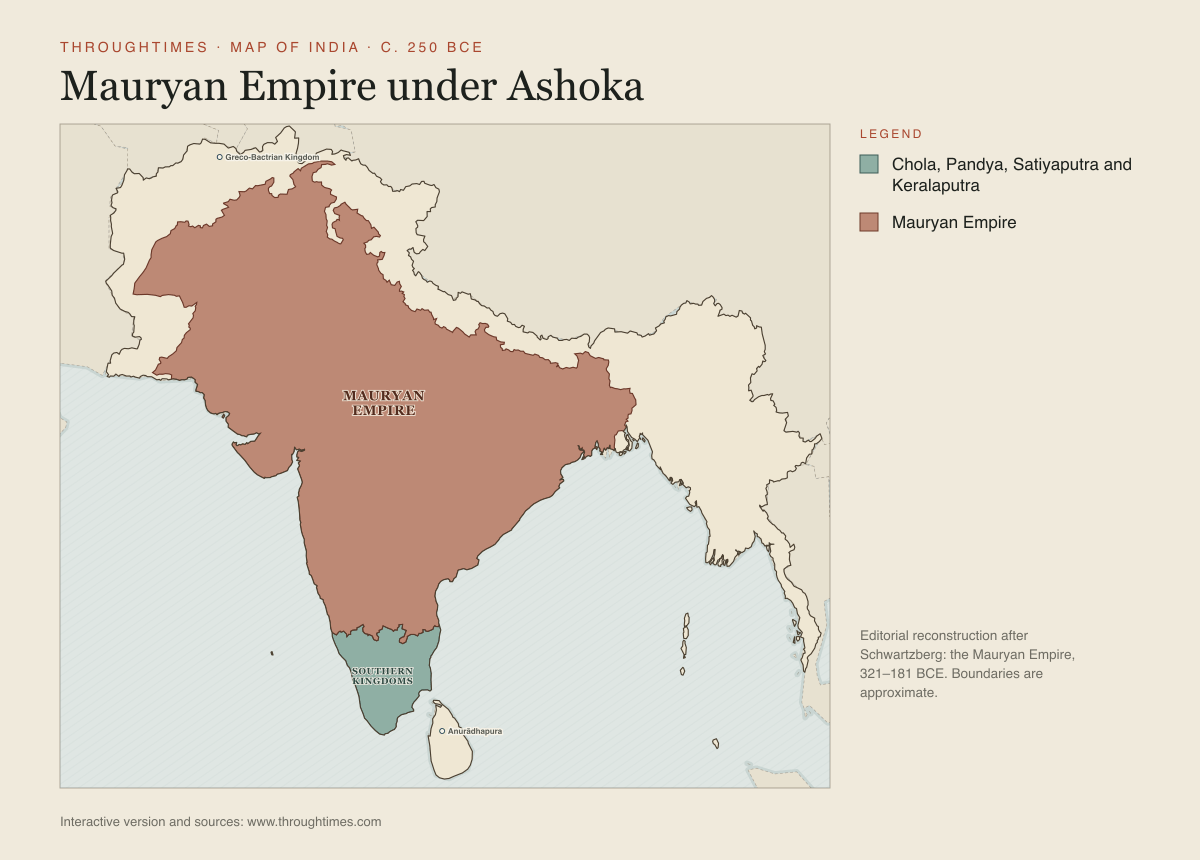
The Mauryan Period at a glance
- When did the Mauryan Empire start and end?
- c. 322–185 BCE.
- Where was the Mauryan Empire located?
- Capital at Pataliputra (modern Patna). At its height under Ashoka it stretched from Afghanistan to Karnataka; only the far south lay outside it.
- Who held power?
- Chandragupta Maurya (c. 322–298 BCE), his son Bindusara, and Ashoka (c. 268–232 BCE), backed by a large army and paid officials.
- How did people live?
- Farming and trade along royal roads, taxes gathered by a central administration, and cities such as Pataliputra and Taxila.
- What ideas and culture shaped it?
- Ashoka’s edicts in Prakrit, Greek and Aramaic, the spread of Buddhism, the Sarnath lion capital, and the Arthashastra, a statecraft treatise traditionally linked to Chanakya (Kautilya).
- How did it end?
- The empire weakened after Ashoka. In about 185 BCE the general Pushyamitra Shunga killed the last Mauryan king, Brihadratha.
Still debated. Reign dates are approximate, and much of the Arthashastra probably took its final form after the Mauryas, so it is not a direct description of their government.
Timeline: how the Mauryan era unfolded
- c. 322 BCE
Chandragupta Maurya, advised by Chanakya, overthrows the Nandas and takes Magadha.
- c. 305–303 BCE
A treaty with Seleucus I gives the Mauryas lands in the north-west; the Greek envoy Megasthenes later visits Pataliputra.
- c. 268 BCE
Ashoka becomes emperor.
- c. 261 BCE
The Kalinga war in present-day Odisha; Ashoka’s remorse is recorded in his edicts.
- c. 250 BCE
Rock and pillar edicts spread Ashoka’s message of dhamma; Buddhist missions travel to Sri Lanka.
- c. 185 BCE
Pushyamitra Shunga overthrows the last Mauryan king.
The Mauryan era, year by year
10 years of this era have a page of their own in the atlas: what happened, who ruled, and the map.
- 322 BCE Who ruled, and the map
- 321 BCE Chandragupta establishes Mauryan rule
- 305 BCE Settlement with Seleucus I
- 300 BCE Pillars and polished stone create an imperial visual language
- 298 BCE Bindusara succeeds Chandragupta
- 273 BCE Ashoka begins his reign
- 261 BCE Kalinga war
- 250 BCE Ashoka’s edicts address the empire
- 232 BCE Ashoka’s reign ends
- 200 BCE Bhaja’s rock-cut caves
Kingdoms and powers of this era
Dates are conventional estimates; several of these powers began before or lasted beyond this era.
- Maurya Empire (322 BCE–185 BCE). Most of the subcontinent; capital Pataliputra. Founded by Chandragupta Maurya; reached its widest extent under Ashoka. Read: The Maurya Empire
मौर्य काल: आसान भाषा में
मौर्य साम्राज्य (लगभग 322–185 ईसा पूर्व) ने पहली बार भारतीय उपमहाद्वीप के अधिकांश भाग पर शासन किया। चंद्रगुप्त मौर्य ने इसकी स्थापना की, और कलिंग युद्ध के बाद सम्राट अशोक ने शिलालेखों के माध्यम से धम्म का संदेश फैलाया।
Maurya Samrajya lagbhag 322 se 185 BCE tak tha. Chandragupta Maurya ne ise banaya aur Samrat Ashok ne Kalinga yuddh ke baad dhamma ka sandesh failaya.
Sources & further reading
Original plain-language summary. Dates for early periods are scholarly estimates; the sources below give fuller detail.