On the eve of Islam. The Byzantine and Sasanian empires are exhausting each other in war, the Sui dynasty has reunified China and the Maya city-states are at their height. In Arabia, Muhammad is about to begin preaching.
The Byzantine and Sasanian empires are exhausting each other in war, the Sui dynasty has reunified China and the Maya city-states are at their height. In Arabia, Muhammad is about to begin preaching.
What happened in the world around 600 CE?
568 · Society
Lombards invade Italy
Led by King Alboin, the Lombards crossed the Julian Alps from Pannonia and overran much of northern Italy, later making Pavia their capital. The invasion ended the brief Byzantine reunification of the peninsula, which stayed politically divided until the 19th century.
The Wari build an expansive highland state from Ayacucho
From their capital near present-day Ayacucho, the Wari extended control over much of highland and coastal Peru from about 600. They built planned provincial centres such as Pikillacta, terraced mountain slopes, laid roads and kept records on knotted cords, anticipating later Inca practice.
K’inich Janaab’ Pakal becomes king of Palenque at the age of twelve
K’inich Janaab’ Pakal took the throne of the Maya city of Palenque, in present-day Chiapas, in 615 and ruled for 68 years. Under him Palenque became a major power; his tomb beneath the Temple of the Inscriptions, opened in 1952, held his carved sarcophagus.
Li Yuan proclaimed the Tang dynasty at Chang’an as the short-lived Sui, which had reunified China in 589, collapsed. Tang rule lasted until 907, and its capital became one of the largest cities in the world.
Facing hostility in Mecca, the prophet Muhammad and his followers moved to Yathrib, later called Medina, where he led a new community. The migration, known as the Hijra, marks year one of the Islamic calendar.
Muslim Arab forces defeated a Byzantine army at the Yarmuk in Syria in 636 and a Sasanian army at al-Qadisiyyah in Iraq (the latter variously dated 636–638). Syria, Iraq and soon Iran passed under the rule of the caliphate.
Amr ibn al-As led a Muslim Arab army into Egypt in 639, took the fortress of Babylon in 641 and received the surrender of Alexandria. He founded Fustat, the forerunner of Cairo, and Egypt began its gradual shift towards the Arabic language and Islam.
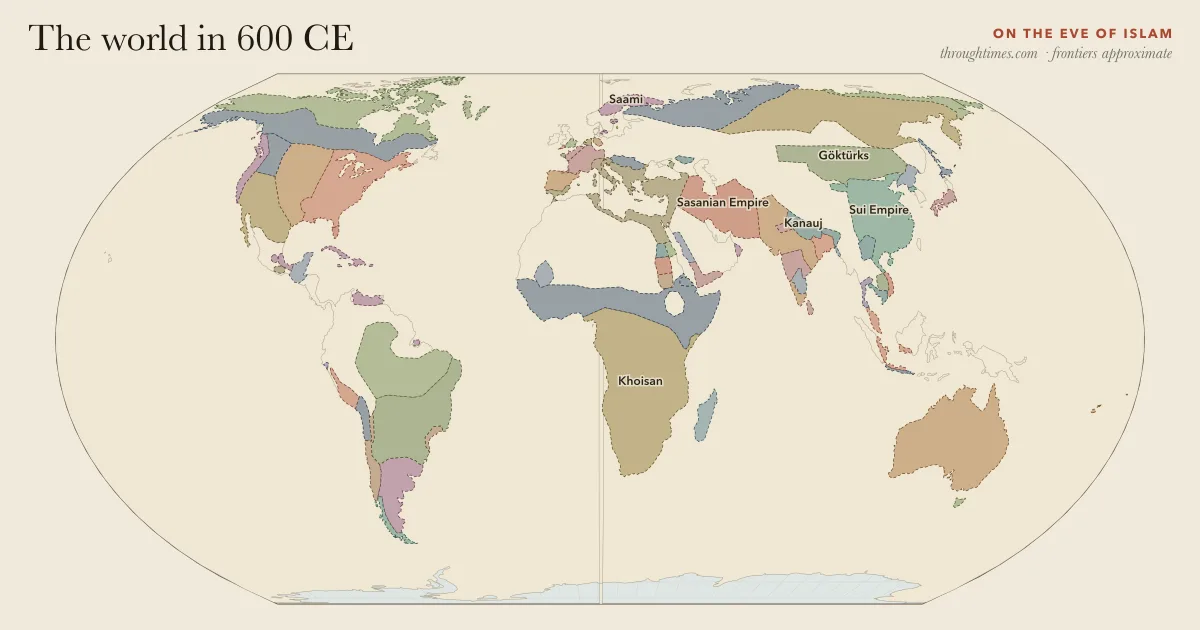
79 powers and peoples are drawn on the map of the world in 600 CE. The largest are listed first; areas are measured from the map and rounded, and most early frontiers are approximate.
Khoisanabout 11 million km² Approximate frontier. Drawn in this atlas from 3000 BCE to 1500 CE.
Australian aboriginal hunter-gatherersabout 7.6 million km² Approximate frontier. Drawn in this atlas from 2000 BCE to 1815 CE.
Paleo-Siberian hunter-gatherersabout 7.2 million km² Approximate frontier. Drawn in this atlas from 2000 BCE to 1200 CE.
Arctic marine mammal huntersabout 5.9 million km² Approximate frontier. Drawn in this atlas from 2000 BCE to 1200 CE.
West African cereal farmersabout 5.9 million km² Approximate frontier. Drawn in this atlas from 1500 BCE to 1500 CE.
Savanna hunter-gatherersabout 4.8 million km² Approximate frontier. Drawn in this atlas from 1500 BCE to 1715 CE.
Subarctic forest hunter-gatherersabout 4.3 million km² Approximate frontier. Drawn in this atlas from 1500 BCE to 1715 CE.
Amazon hunter-gatherersabout 4.3 million km² Approximate frontier. Drawn in this atlas from 1500 BCE to 1715 CE.
Sui Empireabout 3.9 million km² Approximate frontier. Drawn in this atlas from 600 CE to 700 CE.
Eastern North American hunter-gatherersabout 3.6 million km² Approximate frontier. Drawn in this atlas from 1500 BCE to 1400 CE.
Also on the map: Finno-Ugric taiga hunter-gatherers, Göktürks, Sasanian Empire, Plain bison hunters, Eastern Roman Empire, Desert hunter-gatherers and 63 more.
World map in 600 CE. On the eve of Islam. Colours mark the power that held each land; pre-modern frontiers are approximate. Download the map
About this map
This is a snapshot of 600 CE, one of 49 drawn years in the atlas. Historical frontiers are adapted from historical-basemaps, André Ourednik and contributors (GPL-3.0), an open project its author describes as work in progress, so borders before the modern era are informed approximations rather than surveyed lines. Many shapes are peoples and cultures rather than states.