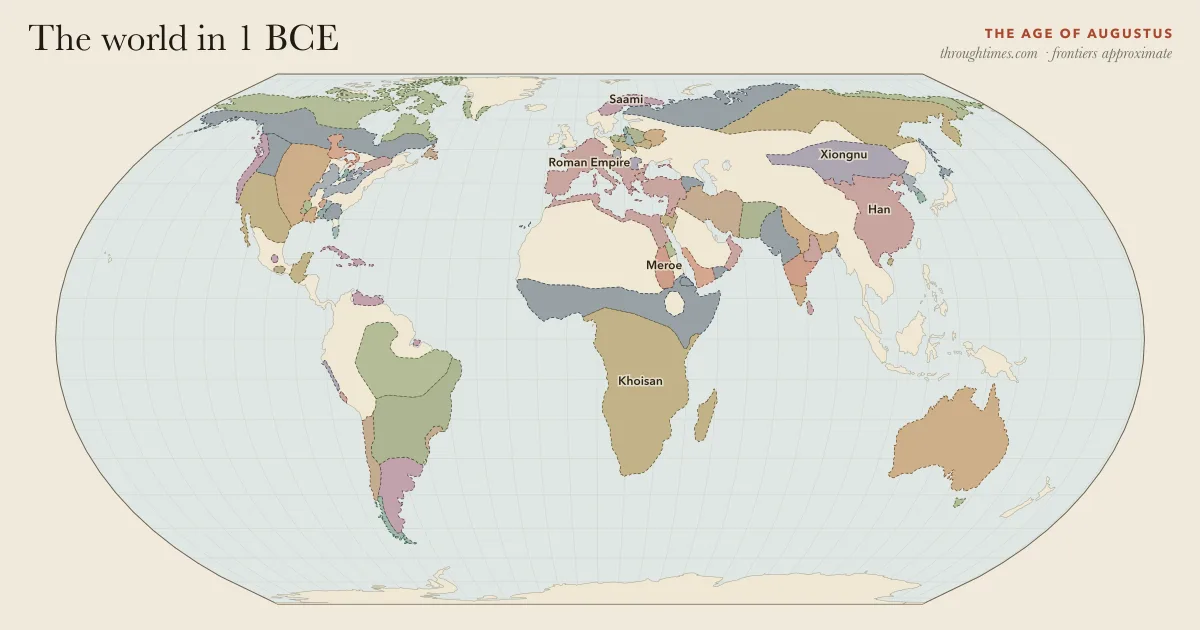
The age of Augustus. Augustus rules a Roman Empire encircling the Mediterranean, Parthia holds Iran, the Han dynasty governs China and Teotihuacan is growing in central Mexico.
Augustus rules a Roman Empire encircling the Mediterranean, Parthia holds Iran, the Han dynasty governs China and Teotihuacan is growing in central Mexico.
What happened in the world around 1 BCE?
15 March 44 BCE · Event
Julius Caesar is assassinated in Rome
Weeks after being named dictator for life, Julius Caesar was stabbed to death by a group of senators led by Brutus and Cassius at a Senate meeting in the Theatre of Pompey complex. The killing failed to restore the Republic and set off a new round of civil wars.
Earliest known Long Count date is carved at Chiapa de Corzo
Stela 2 at Chiapa de Corzo in Chiapas bears the oldest Long Count calendar date yet found, equivalent to December 36 BCE; Stela C at Tres Zapotes follows in 32 BCE. The positional system, which relied on a concept of zero, was later elaborated by the Maya.
Cleopatra VII dies and Egypt becomes a Roman province
After Octavian’s forces took Alexandria, Cleopatra VII, the last Ptolemaic ruler, took her own life. Egypt passed under direct Roman control, ending the long line of independent pharaonic kingship and making the Nile valley a main source of grain for Rome.
After defeating Antony and Cleopatra at Actium, Octavian formally returned power to the Senate, which in 27 BCE granted him the name Augustus. He kept control of the armies and key provinces, replacing the Republic with the rule of one man.
Voyagers settle the Marshall Islands and eastern Micronesia
Around 2,000 years ago, by most archaeological estimates, canoe voyagers probably coming from the Solomon Islands and Vanuatu region settled the atolls of the Marshall Islands and the high islands of Kosrae, Pohnpei and Chuuk. Their descendants became master navigators of the open Pacific.
Cahuachi serves as the ceremonial centre of the Nazca
Cahuachi, a complex of some forty adobe mounds overlooking the Nazca River, was the chief ceremonial and pilgrimage centre of Nazca society from about the first century CE. It had few permanent residents and was abandoned around 500.
Jesus, a Jewish preacher from Galilee, was executed by crucifixion in Jerusalem under the Roman prefect Pontius Pilate, most likely in 30 or 33 CE. His followers’ belief in his resurrection became the foundation of Christianity.
76 powers and peoples are drawn on the map of the world in 1 BCE. The largest are listed first; areas are measured from the map and rounded, and most early frontiers are approximate.
Khoisanabout 12 million km² Approximate frontier. Drawn in this atlas from 3000 BCE to 1500 CE.
Australian aboriginal hunter-gatherersabout 7.6 million km² Approximate frontier. Drawn in this atlas from 2000 BCE to 1815 CE.
Paleo-Siberian hunter-gatherersabout 7.2 million km² Approximate frontier. Drawn in this atlas from 2000 BCE to 1200 CE.
West African cereal farmersabout 5.9 million km² Approximate frontier. Drawn in this atlas from 1500 BCE to 1500 CE.
Arctic marine mammal huntersabout 5.9 million km² Approximate frontier. Drawn in this atlas from 2000 BCE to 1200 CE.
Savanna hunter-gatherersabout 4.8 million km² Approximate frontier. Drawn in this atlas from 1500 BCE to 1715 CE.
Roman Empireabout 4.4 million km² Approximate frontier. Also held Bosporian Kingdom, Judea, Odrysian Kingdom. Drawn in this atlas from 1 BCE to 200 CE.
Amazon hunter-gatherersabout 4.3 million km² Approximate frontier. Drawn in this atlas from 1500 BCE to 1715 CE.
Subarctic forest hunter-gatherersabout 4.1 million km² Approximate frontier. Drawn in this atlas from 1500 BCE to 1715 CE.
Hanabout 4.0 million km² Approximate frontier. Drawn in this atlas from 1 BCE to 200 CE.
Also on the map: Xiongnu, Finno-Ugric taiga hunter-gatherers, Plain bison hunters, Desert hunter-gatherers, Parthian Empire, Pampas cultures and 60 more.
World map in 1 BCE. The age of Augustus. Colours mark the power that held each land; pre-modern frontiers are approximate. Download the map
About this map
This is a snapshot of 1 BCE, one of 49 drawn years in the atlas. Historical frontiers are adapted from historical-basemaps, André Ourednik and contributors (GPL-3.0), an open project its author describes as work in progress, so borders before the modern era are informed approximations rather than surveyed lines. Many shapes are peoples and cultures rather than states.