Eras of Indian history · 1500–600 BCE
The Vedic Period
The Vedic period is named after the Vedas, the oldest texts of Hinduism, composed in early Sanskrit and passed down by memory for centuries. Communities began as cattle-herding clans in the north-west and slowly settled into farming villages and small kingdoms across the Ganga plain.
See 1000 BCE on the map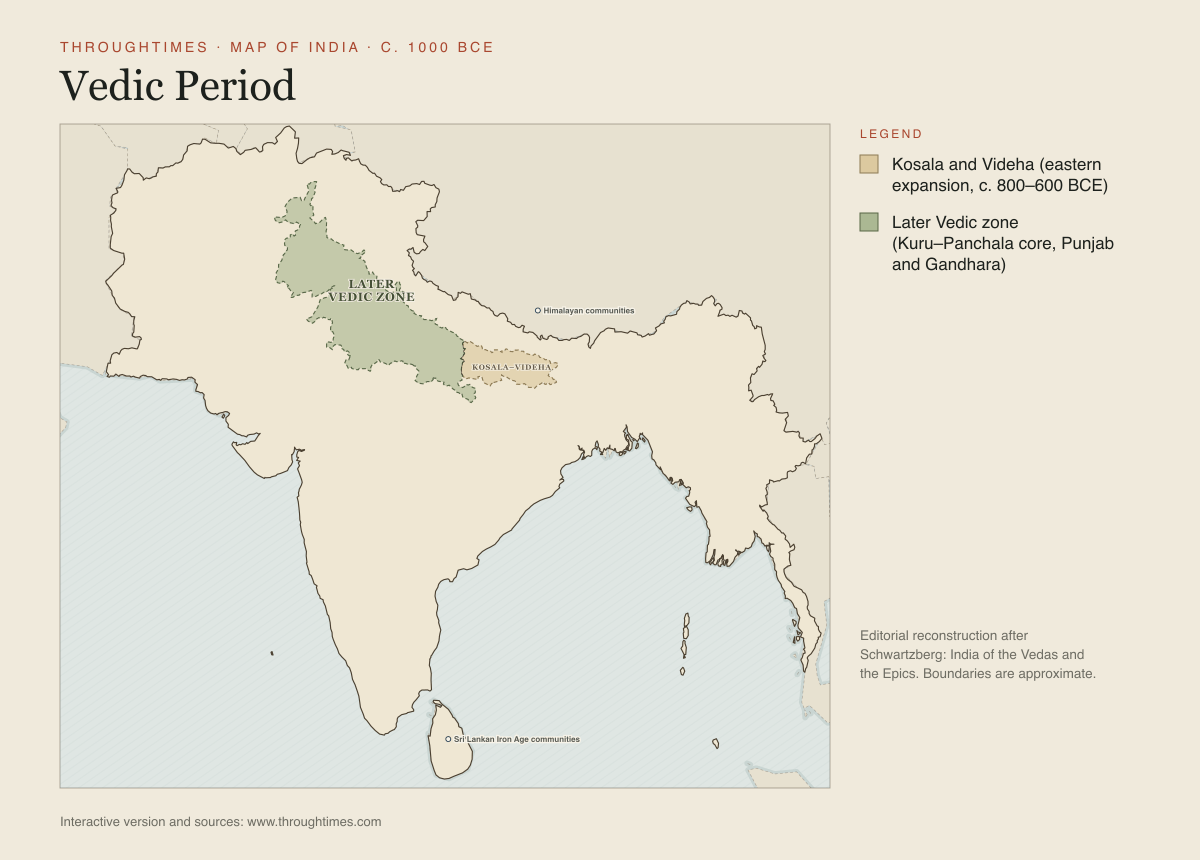
The Vedic Period at a glance
- When was the Vedic period?
- c. 1500–600 BCE. Historians divide it into the Early (Rigvedic) period, c. 1500–1000 BCE, and the Later Vedic period, c. 1000–600 BCE.
- Where did the Vedic period take place?
- First the Punjab region, the “land of seven rivers”, then eastward into the upper and middle Ganga plain.
- Who held power?
- Clan chiefs called rajas, advised by assemblies such as the sabha and samiti. Later, larger kingdoms such as Kuru and Panchala.
- How did people live?
- Cattle herding at first, then settled farming. Iron tools became common in the later phase, and society was increasingly divided into four varnas.
- What ideas and culture shaped it?
- The four Vedas, then the Brahmanas and the Upanishads; fire sacrifices (yajna), and later new questions about karma, rebirth and the self.
- How did it end?
- Kingdoms grew larger and towns reappeared on the Ganga plain, leading into the age of the sixteen Mahajanapadas.
Still debated. Where the Vedic people’s language and culture came from is debated. Most linguists and geneticists favour a gradual arrival of Indo-Aryan speakers from Central Asia during the second millennium BCE; others argue for an origin within the subcontinent. All dates for the Vedas are estimates.
Timeline: how the Vedic worlds era unfolded
- c. 1500–1200 BCE
The earliest hymns of the Rigveda are composed in the Punjab region.
- c. 1000 BCE
The Later Vedic period begins as settlement moves east into the Ganga plain and iron tools spread.
- c. 1000–800 BCE
The Kuru kingdom becomes the first large Vedic state and a centre of ritual and learning.
- c. 700 BCE
The earliest Upanishads explore ideas of the self, karma and rebirth.
- c. 600 BCE
Bigger kingdoms and new towns mark the move into the Mahajanapada age.
The Vedic worlds era, year by year
7 years of this era have a page of their own in the atlas: what happened, who ruled, and the map.
वैदिक काल: आसान भाषा में
वैदिक काल (लगभग 1500–600 ईसा पूर्व) का नाम वेदों से पड़ा। शुरुआत में पशुपालक कबीले पंजाब क्षेत्र में रहते थे; उत्तर वैदिक काल में लोग गंगा के मैदान में खेती करने लगे और कुरु-पांचाल जैसे राज्य बने।
Vedic Kaal lagbhag 1500 se 600 BCE tak tha. Rigveda sabse purana granth hai, aur baad mein log Ganga ke maidan mein kheti karne lage.
Sources & further reading
Original plain-language summary. Dates for early periods are scholarly estimates; the sources below give fuller detail.